
Checkpoint vs CCH AnswerConnect: tax research software comparison guide for 2026

Will switching tax research platforms save you time, or just give you a different place to search?
Thomson Reuters Checkpoint and Wolters Kluwer CCH AnswerConnect are established tax research platforms that pair authoritative tax content with AI-assisted capabilities. Both tools grant you access to research resources to help you work through complex tax questions, review supporting authority, and guide professional conclusions.
However, your decision shouldn’t stop at surface-level factors like features, pricing, and polished demos alone.
Look for a tool that uncovers hard-to-find tax authorities, traces the reasoning behind an answer, supports your team’s research process, and aligns with your budget and long-term tax research needs.
This guide compares Checkpoint and CCH AnswerConnect across research content, AI capabilities, workflow support, integrations, pricing, and user reviews. You’ll walk away with the details you need to make a more informed decision about the platform that best fits your firm.
Checkpoint vs CCH AnswerConnect: at a glance
The comparison below shows how Checkpoint and CCH AnswerConnect approach tax research across content, AI assistance, workflow support, integrations, and pricing.
Checkpoint Edge provides Thomson Reuters’ tax research content, while CoCounsel provides AI-assisted research capabilities. CCH AnswerConnect combines Wolters Kluwer’s tax research content with Expert AI for AI-assisted research. Both platforms cover US tax research offerings.
Note: Vendor information reflects details available as of October 2026. Verify current features, pricing, and availability directly with each provider.
Let’s take a closer look at how each platform approaches the research process, from the authority behind answers to the workflows that help you apply them.
The research foundation behind each platform: authority, expertise, and content coverage
When you’re evaluating tax research tools, start with the foundation behind every answer: the quality, depth, and coverage of the tax content available to your team.
Checkpoint combines Thomson Reuters Checkpoint content with CoCounsel’s AI-assisted research capabilities. With it, you can access primary tax authorities, including IRS sources and government materials, alongside citation-backed answers that link research findings to the supporting sources behind each conclusion.
CCH AnswerConnect combines Wolters Kluwer’s tax research content, CCH expert analysis, and Expert AI. The platform gives you access to tax authority, practical guidance, and editorial insights. It connects AI-generated answers to the underlying authorities that support a tax conclusion.
Compare the research foundations, and focus on whether each platform gives your team access to the materials they need, including federal, state, international, and specialist tax resources required for their specific practice areas.
How AI transforms tax research: from searching for answers to validating conclusions
CoCounsel Tax is Thomson Reuters’ generative AI assistant. You can ask tax questions in natural language, receive citation-backed answers, explore relevant authorities, and analyze tax documents as part of your workflow.
The tool connects your AI-assisted research with Checkpoint content, helping you move beyond traditional search methods while keeping the supporting authority available for review.
CCH AnswerConnect’s Expert AI lets you ask tax questions naturally, review answers supported by source materials, and explore relevant information using CCH’s expert-reviewed content environment as the backing authority.
Expert AI helps you interact with tax research more efficiently while keeping the underlying authority available so you can validate conclusions before using them.
Both CoCounsel and Expert AI support conversational tax research that addresses user-experience challenges associated with legacy tax research tools, where you may otherwise spend more time navigating complex searches and manually reviewing sources to find answers.
How each platform moves research into a reviewed client deliverable
You’ll need to consider whether the platform supports your entire tax research workflow, not just the initial research process of finding authoritative sources. A useful research platform should help you:
- Verify answers with supporting authorities
- Understand the reasoning behind a conclusion
- Move directly from research findings to practical tax work
CoCounsel Tax supports your workflow by combining Checkpoint content, IRS sources, and government materials in one workspace. You can ask complex tax questions, analyze multiple documents, and draft client deliverables with supporting citations for professional review.
CCH AnswerConnect supports your research workflow by providing citation-backed answers with direct links to source law, helping you validate conclusions quickly. It connects answers, authorities, implications, and related issues in one platform while allowing you to analyze client files and internal materials through its document analysis features.
How integrations connect tax research with the systems your firm already uses
Strong integrations can help your team move seamlessly between research, compliance, preparation, and advisory workflows while maintaining the processes you already have in place.
Checkpoint with CoCounsel Tax maintains connections with Thomson Reuters tax and accounting solutions, making it a potential fit for firms already using its products across their practice.
CCH AnswerConnect connects with Wolters Kluwer tax solutions, including CCH tax preparation products like CCH Axcess, helping firms that rely on the CCH ecosystem maintain a more connected workflow.
Pricing and adoption considerations
Consider the tool’s subscription cost, what each solution includes, and how it fits your team’s workflow.
CoCounsel pricing starts at $1,300 per year for one user. However, your total investment may expand depending on the additional Checkpoint features you select, including Checkpoint Edge access, content options, and the research solutions your practice requires. If your team relies on a broader range of Thomson Reuters resources, you’ll need to weigh the complete package against your research demands and workflow requirements to determine the right fit for your firm.
CCH AnswerConnect starts at $1,499 for its tax package, with pricing varying based on the content packages and research capabilities you select. As you evaluate the platform, align the CCH resources you select with your workflow needs and determine how effectively the platform connects with your existing Wolters Kluwer ecosystem.
Learn how firms are approaching AI adoption with our guide on tax research adoption gap.
Thomson Reuters Checkpoint Edge and CoCounsel Tax overview
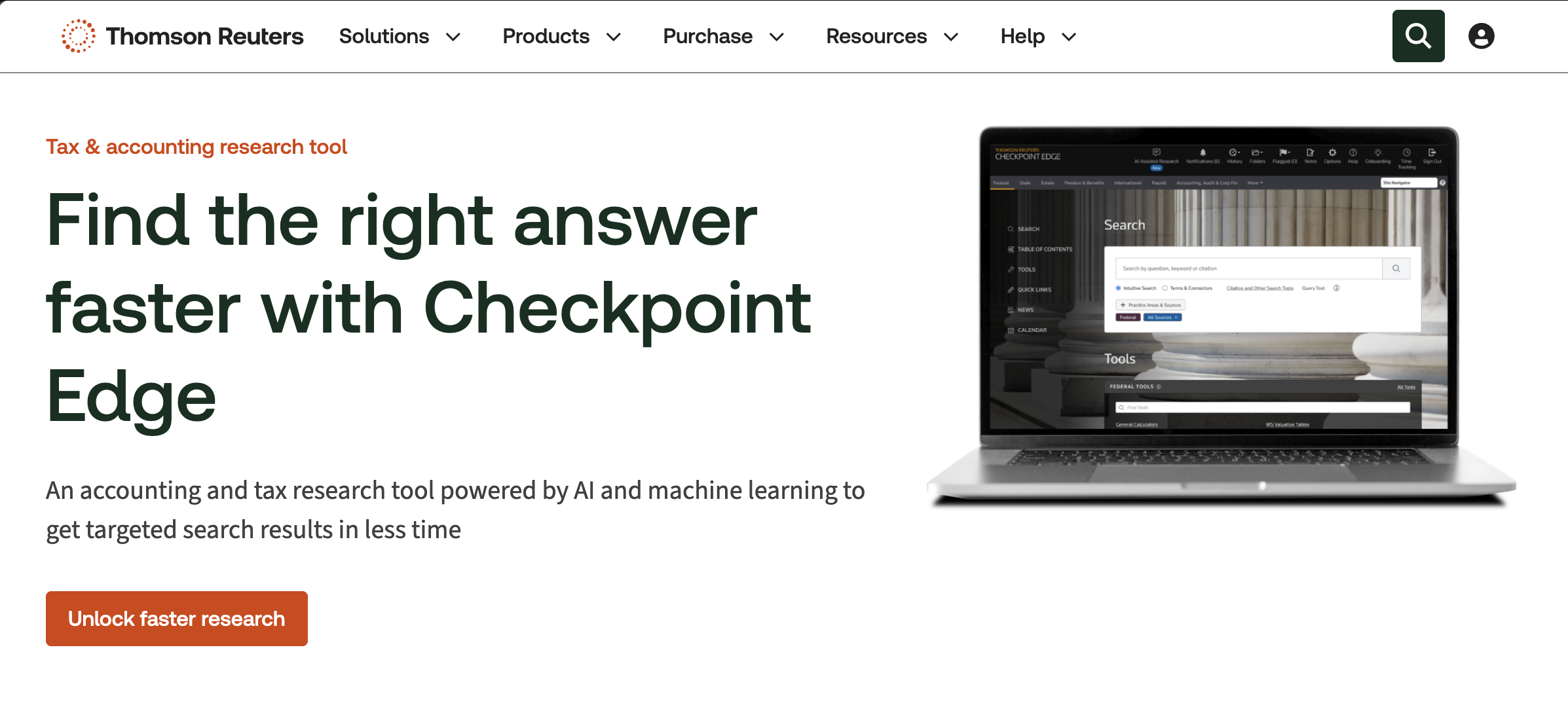
Best for: accounting firms and tax departments that want to combine authoritative research, firm documents, drafting, and repeatable workflows in one AI workspace.
Thomson Reuters Checkpoint is a tax and accounting research ecosystem that brings together authoritative content, editorial analysis, and professional research tools. If you manage complex tax matters, you can use Checkpoint to tap into a broad range of resources that help you uncover relevant issues, verify authority, and apply your findings to client work.
Checkpoint Edge serves as your research environment, anchoring your work with access to tax content, primary authority, editorial insights, and research capabilities.
CoCounsel Tax adds an AI assistant layer that helps you navigate Checkpoint content through conversational research, document analysis, and citation-backed answers.
Benefits of Checkpoint with CoCounsel Tax
The benefits of Checkpoint with CoCounsel Tax come down to how it helps you research, analyze, and apply tax information.
Key capabilities include:
- Authoritative tax research foundation: access primary tax authorities, including the Internal Revenue Code, Treasury Regulations, IRS guidance, and court decisions, alongside Thomson Reuters expert analysis.
- Expert-developed tax insights: combine primary authority with practitioner-focused commentary and editorial resources that help explain how tax rules apply to specific situations.
- Connected AI-assisted features: use CoCounsel Tax capabilities, including conversational research, document analysis, citation-backed answers, and support for moving research findings into practical tax work.
Key features of Checkpoint Edge with CoCounsel Tax
The key features of Checkpoint Edge with CoCounsel Tax support different stages of your tax research workflow.
- AI-powered search: helps users ask tax questions in full phrases and natural language while locating relevant research content.
- Knowledge Base: brings firm knowledge into CoCounsel.
- Advisory Maps: provide step-by-step guidance and implementation aids for tax planning and advisory engagements.
- Concept markers: allow users to select related concepts and refine or reorganize search results.
- State charts: provide multistate tax comparisons with access to primary law and editorial explanations.
- Topic summary pages: provide structured starting points for researching tax topics.
- Document comparison: compare current and historical versions of official tax documents.
CoCounsel Tax pricing
CoCounsel Tax pricing starts at $1,300 per user per year and includes AI-assisted research capabilities, document upload and analysis, workspaces and templates, client and project features, and administrative management tools.
Wolters Kluwer’s CCH AnswerConnect overview
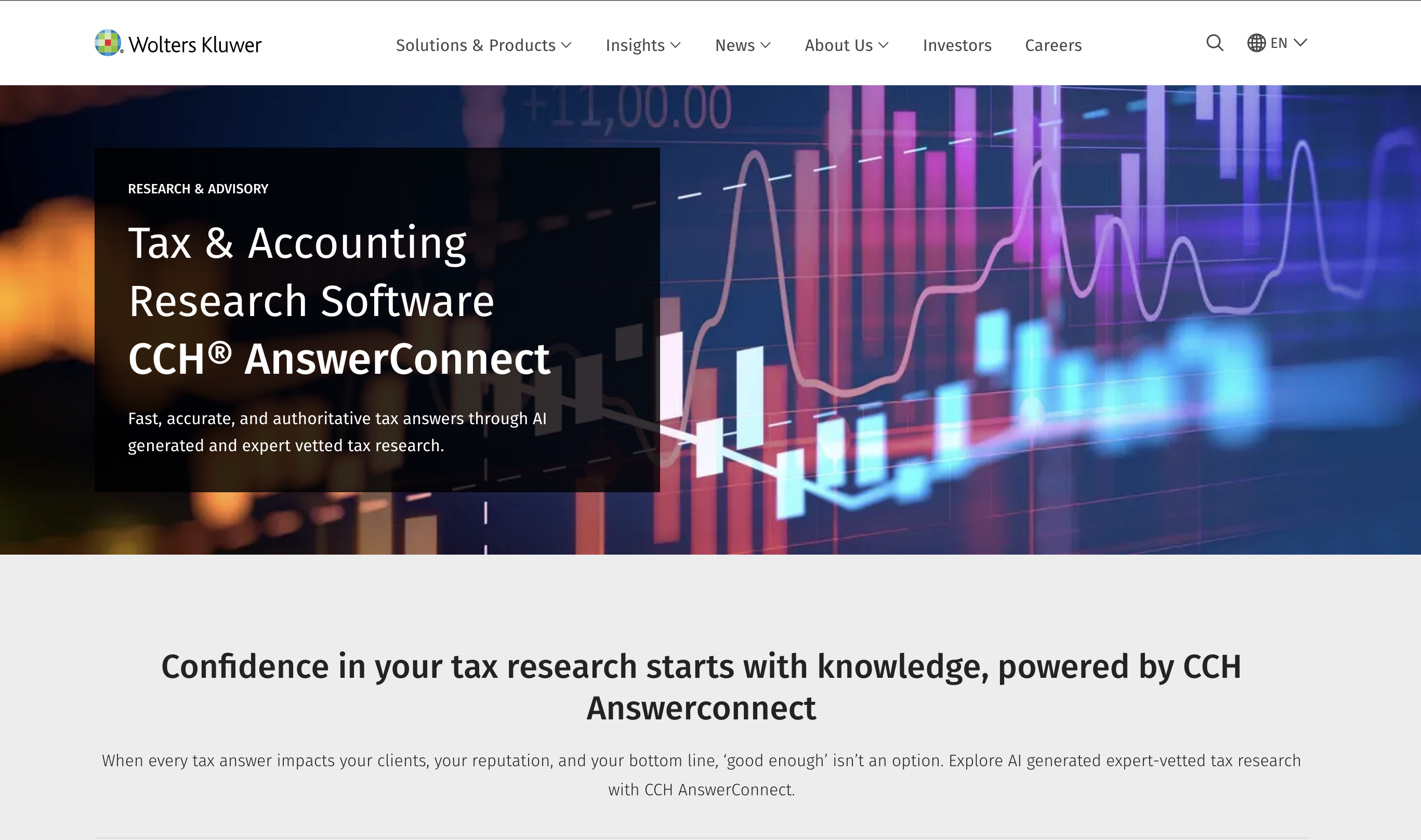
Best for: tax firms that want AI-assisted research backed by Wolters Kluwer’s CCH editorial analysis and primary authority.
CCH AnswerConnect is Wolters Kluwer’s tax and accounting research platform. It brings together primary tax authority, CCH editorial analysis, practical guidance, research tools, document analysis, and AI-assisted research features in one environment.
You can use the platform to navigate complex tax issues, unpack how tax rules apply, and trace supporting sources before applying your findings to client matters.
If your firm already uses Wolters Kluwer solutions, CCH AnswerConnect can weave your research process into existing tax preparation and compliance workflows.
Benefits of CCH AnswerConnect
The benefits of CCH AnswerConnect come from bringing authoritative sources, practical guidance, and research tools together in one environment.
Key capabilities include:
- Expert-reviewed tax research foundation: CCH AnswerConnect combines primary tax authorities, including the Internal Revenue Code, Treasury Regulations, IRS guidance, and court cases, with CCH editorial analysis.
- Practical tax guidance and interpretation: the platform helps you understand how tax rules apply to real client situations and complex research questions through expert-reviewed content.
- Connected tax and accounting workflows: the tool integrates tax research with Wolters Kluwer solutions, including CCH tax products, to support firms managing research, compliance, and tax preparation processes.
Key features of CCH AnswerConnect
Here are the key features of CCH AnswerConnect:
- Expert AI-powered research: provides AI-generated tax research answers based on expert-vetted CCH content with citations and links to supporting sources.
- Practical tools and practice aids: use Smart Charts, calculators, and client memo tools to turn research into client-ready outputs.
- Client document analysis: allows users to upload tax returns, agreements, financial statements, notices, and other documents to analyze client facts.
- Tax news: helps users follow federal, state, and international tax developments.
- Workflow integrations: connects with CCH Axcess Tax, CCH ProSystem fx Tax, ATX, and TaxWise.
CCH AnswerConnect pricing
CCH AnswerConnect pricing starts with the Tax package, which begins at $1,499 per year per user. Additional plans are available by quote, depending on the content, features, and access your firm requires. Wolters Kluwer also offers a seven-day free trial for users who want to explore the platform before committing.
If you’re building your shortlist of tax research platforms, explore our guide to the best CCH AnswerConnect alternatives and compare solutions that may fit your team’s workflow.
How to evaluate tax research software before choosing a platform
Here are the factors you should consider when choosing between tax research platforms. These factors serve as guardrails, helping you identify how each solution supports the path from research questions to client-ready conclusions.
Match the platform to the tax questions your firm actually handles
The right tax research platform should fit the way your team works, whether you handle routine tax questions or complex research across multiple areas and jurisdictions.
A firm that mainly handles routine federal tax questions, such as determining whether a specific expense is deductible, may have different research needs from a firm advising on complex matters involving multiple jurisdictions, business structures, and tax planning decisions.
Start by evaluating:
- Practice area requirements: consider whether your firm focuses on federal tax, state and local tax, international tax, business tax, compliance, advisory work, or a combination of these areas.
- Research volume and complexity: evaluate whether the platform can support the number of research questions your team handles and the complexity of the issues you regularly investigate.
- Team structure: consider whether the solution fits individual practitioners, specialized tax teams, or firm-wide adoption across multiple departments.
Follow the research trail: verifying answers and applying authority confidently
Finding relevant information is only one part of tax research. Professionals also need to confirm the authority behind a conclusion and apply that information to client matters with confidence.
When evaluating a platform, consider:
- Source verification: assess how easily practitioners can review supporting authorities and confirm the basis for a conclusion.
- Research efficiency: consider whether the platform reduces time spent locating, organizing, and reviewing relevant information.
- Practical application: evaluate whether research findings can support client communications, tax memoranda, recommendations, and other deliverables.
Look beyond the AI label: evaluate how the platform supports professional tax judgment
An AI feature alone doesn’t determine the value of a tax research platform. The difference lies in whether the technology can cut through complex research questions, surface reliable answers, reveal the authority behind them, and support the judgment required in professional tax work.
Consider:
- Quality of underlying sources: evaluate whether AI-generated responses are supported by reliable tax authorities and research materials.
- Citation visibility: check whether practitioners can review the sources behind an answer and verify the supporting analysis.
- Natural language interaction: assess whether users can ask tax questions conversationally and refine research through follow-up questions.
- Workflow support: consider how AI connects research findings with broader tax activities, including compliance, advisory work, and tax writing.
Generative AI in tax can improve the research experience by helping professionals find relevant information, understand the supporting authority, and continue their analysis efficiently.
Research from a Stanford and MIT AI accounting study explores how AI tools affect accounting professionals’ work and provides insight into how human expertise and AI capabilities can work together in professional settings.
Remove adoption barriers: choose a platform your team will actually use
Another factor to consider is how easily your team can adopt and continue using the platform after implementation.
Your team should be able to understand the platform, complete common tasks, and become comfortable with the workflow without requiring excessive training or support.
Beyond the initial learning period, customer support and technical assistance can determine how confidently your team continues using the tool. Responsive support, helpful resources, and reliable IT guidance can help practitioners resolve issues quickly and keep their research process moving.
Over time, user experience and interface design shape whether the platform becomes a natural part of your team’s daily work. Some legacy tax research tools create unnecessary friction through outdated interfaces and complicated workflows, which can make consistent use more difficult. Look for a solution that feels intuitive, supports smooth navigation, and helps your team complete research tasks without adding extra steps.
Blue J tax research: from tax questions to defensible answers
.png)
After comparing Checkpoint and CCH AnswerConnect, you can also explore other AI-powered tax research platforms. Considering a solution like Blue J can help you understand how different solutions approach the journey from a complex tax question to a supported conclusion.
Blue J reshapes the research experience by allowing you to work through tax questions in plain language. Through its AI native conversational research experience, you can describe complex tax issues in simple terms and receive answers supported by primary authoritative content, supplemented by expert commentary from Tax Notes and IBFD.
Instead of treating AI-generated responses as the final step, Blue J grounds its answers in verifiable sources, allowing you to trace the information behind each response and review the authority supporting the analysis.
This gives you the foundation to evaluate research findings, apply professional judgment, and develop defensible conclusions for client matters.
To understand how Blue J supports this process, it helps to examine the sources behind its answers, how practitioners verify conclusions, and the capabilities that connect research with professional work.
Where Blue J gets its answers: the authorities powering AI-assisted research
.png)
Blue J hands you tax research answers you can review and verify against authoritative sources.
Blue J draws from:
- Primary tax authority: access statutes, regulations, cases, IRS guidance, treaties, and other government materials that form the foundation of tax analysis.
- Tax-focused secondary content: Tax Notes content is used for expert analysis, tax developments, and commentary that helps explain complex tax issues.
- International tax resources: IBFD content is used for cross-border tax research, including treaty analysis, country commentary, and global tax guidance.
- Maintained research content: Blue J’s legal research team curates and maintains the tax content available throughout the platform.
Follow every answer back to the authority behind it
.png)
When Blue J provides an answer, you can follow the research trail behind it. The platform links responses to cited sources, allowing you to open referenced authorities, review supporting materials, and examine the basis behind the analysis.
The platform also lets you explore the issue in the same research conversation by asking follow-up questions, reviewing related authorities, and refining your analysis without starting a new search.
For example, when researching an asset allocation question, you can:
- Review the answer
- Open the cited authorities supporting the allocation rules
- Examine relevant excerpts
- Explore related considerations such as exceptions or adjustments
This approach helps you validate the authority behind each answer, assess the reasoning, and apply your professional judgment before reaching a final tax conclusion.
From research question to client deliverable: turning tax analysis into professional work
The tax research process doesn’t end when you find the relevant authorities supporting a tax position. You still need to turn your research into clear explanations and practical recommendations that help address the client’s tax issue.
Blue J moves you from the initial point of research to client communication by:
- Starting with a question: ask tax questions conversationally, similar to working with a trusted colleague who shows the reasoning behind their answer.
- Building defensible answers: review responses supported by primary authoritative content, Tax Notes, and IBFD resources.
- Verifying the foundation: trace answers back to sources you can review and confirm before applying your analysis.
- Turning tax research into client-ready work: transform completed research into draft client deliverables and translate complex tax analysis into clearer client communications.
Explore pricing to see which Blue J plan fits your firm’s research needs.
Frequently asked questions about Checkpoint vs CCH AnswerConnect
What is the difference between Checkpoint Edge and CCH AnswerConnect?
The difference between Checkpoint Edge and CCH AnswerConnect is how they structure their research ecosystems and AI-assisted workflows. Checkpoint Edge combines Thomson Reuters’ tax research content with CoCounsel Tax for AI-assisted research, document analysis, and citation-backed answers.
CCH AnswerConnect combines Wolters Kluwer’s tax research content with CCH expert analysis and Expert AI to support AI-assisted research. Your choice depends on the content, workflows, and integrations your firm needs most.
Which tax research software is best for accounting firms?
The best tax research software for accounting firms depends on how your team works and the systems you already rely on.
Firms using Thomson Reuters solutions may find CoCounsel Tax a good fit because it integrates naturally with their existing research and accounting workflows. Whilst firms built around Wolters Kluwer solutions may find the CCH AnswerConnect option aligns closely with their tax preparation and research processes.
But if you’re exploring other AI-powered approaches, platforms such as Blue J introduce a workflow built around conversational tax research, citation-backed answers, and drafting support while keeping professional review at the center of the process.
Blue J is already used by over 6,000+ organizations, including Big Four firms and Fortune 100 companies, and over 70% of users log in weekly for tax research and client-facing outputs such as emails and memos.
That level of usage suggests practitioners are using it beyond one-off research questions and carrying the work into deliverables clients actually see.
How accurate are AI tax research answers?
AI tax research accuracy depends on the quality of the underlying content, how sources are selected, and whether the platform allows practitioners to verify supporting authorities.
Look for platforms that link answers to reliable sources, surface supporting citations, and open a clear path to reviewing the authority behind a conclusion. AI can accelerate information discovery, but practitioners still need to evaluate the authority, apply the facts, and exercise professional judgment.
Should firms choose an AI-powered tax research platform or a traditional research library?
Firms choosing between AI-powered tax research platforms and traditional research libraries should weigh the benefits each offers.
With traditional tax research libraries, you can find relevant authorities by searching through extensive collections of tax materials, including statutes, regulations, cases, and guidance.
But AI-powered tax research platforms shrink the time spent searching for authorities by offering a conversational search feature that allows you to ask tax questions and get answers with citations you can verify.
So if you desire to spend less time searching through numerous documents and more time advising clients and planning strategies, then go for AI-powered research options like Blue J.
Is Blue J an alternative to Checkpoint or CCH AnswerConnect?
Blue J can serve as an alternative to Checkpoint or CCH AnswerConnect for sole practitioners and local, regional, and national firms.
The platform allows you to ask complex questions in plain language, receive defensible answers supported by authoritative sources, review the reasoning behind conclusions, and turn research findings into client-ready deliverables.
While Checkpoint and CCH AnswerConnect are established tax research platforms with extensive content libraries, Blue J combines conversational research, curated tax content, and AI-assisted analysis in one workflow.
The tax solution is currently trusted by over 10,000 firms, including 3 out of 4 Big Four firms and Fortune 100 companies.

Stay up to date