
How to do tax research: A step-by-step process for finding, evaluating, and applying tax authority

A client’s question can mask the real tax issue you need to consider.
They may ask, “Can we deduct these research and development costs under the current rules?” or “What are the tax consequences of restructuring across multiple entities?”
Both give you a starting point. Before you can answer, you need to:
- Establish the facts behind the client’s request
- Identify the specific tax issues those facts raise
- Apply the relevant authorities to the client’s situation
Your client needs a recommendation they can use to make an informed decision or meet their compliance obligations. A structured tax research process helps you develop that recommendation and explain the reasoning behind it.
This guide walks you through six process steps, with practical examples showing how to turn a client’s question into a supported tax position ready for review.
The six-step tax research process

While we’ve outlined six practical steps for conducting tax research, it’s important to understand that the process rarely follows a straight line. A new fact may change the issue, a new authority may expose missing facts, and conflicting guidance may prompt you to reassess your conclusion.
With that in mind, here are the six steps at a glance:
- Establish the facts: build a complete picture of the taxpayer, transaction, timing, jurisdiction, and surrounding circumstances.
- Identify the tax issues: turn the client’s concern into the specific legal and factual questions that will determine the outcome.
- Locate the relevant authority: find the statutes, regulations, administrative guidance, judicial decisions, and supporting secondary sources that address the issue.
- Check and evaluate the authority: determine whether the authority is current, applicable, persuasive or binding, and strong enough to support the position.
- Develop conclusions and recommendations: apply the authority to the facts, explain any uncertainty, and reach a recommendation the client can act on.
- Communicate the findings: document the reasoning clearly in a memo, client communication, or other deliverable so another practitioner can follow how you reached the conclusion.
Step 1: Establish the facts before searching for tax authority
The tax treatment of a payment, transaction, or expense depends on who is involved and what happened.
Before researching the law, ask your client questions to establish the taxpayer, the transaction’s purpose, the amounts involved, and the surrounding circumstances. Build your analysis on confirmed facts, not assumptions.
Start with the five questions: who, what, when, where, and how
Identify who is involved
Start by identifying the taxpayer and the other parties connected to the transaction.
Ask your client questions like:
- Who is the taxpayer?
- Is the taxpayer an individual, corporation, partnership, trust, or estate?
- Are related parties involved?
- What is the taxpayer’s filing status?
- Does the taxpayer have a special tax status, such as tax-exempt status under IRC § 501(c)(3) or an S corporation election?
These details can affect which tax rules apply and how the transaction is treated.
For example, if the corporate client paid $250,000 to its majority shareholder and wants to deduct the payment, then you need more information about the relationship between the corporation and the shareholder.
You can ask the client questions like is the shareholder also an employee? Or was there a shareholder loan? These provide solid context before you determine what the payment actually was.
Establish what happened
Next, identify the transaction itself by asking:
- What transaction occurred?
- What property, payment, or service is involved?
- Was income received?
- Was an expense incurred?
- Was property transferred?
This is where you determine whether the $250,000 payment was compensation, a distribution, repayment of a loan, or something else.
That classification is important because different tax rules can apply depending on what the payment represents.
Confirm when it happened
Sometimes, timing may affect both the applicable law and the tax treatment. So you should find out:
- When was income received?
- When was an expense paid?
- When was property placed into service?
- What tax year is involved?
A transaction that occurred in one tax year may be subject to different rules than the same transaction in another year.
Timing can also affect when income, deductions, or other tax consequences are recognized.
Determine where it happened
Tax rules differ across states and countries, so the jurisdictions involved can change the client’s tax obligations.
Identify the relevant jurisdictions by asking:
- Which state is involved?
- Are foreign jurisdictions involved?
- Where does the taxpayer operate?
Identifying the relevant jurisdictions early helps you avoid researching rules that don’t apply to the client’s situation.
Understand how the transaction occurred
Look at how the transaction was structured and documented. To get a better picture of how the transaction occurred, ask questions like:
- What contracts exist?
- How were payments structured?
- What records support the transaction?
The documents behind a transaction can be just as important as the client’s description of it. Contracts, payment records, agreements, and other documentation can confirm what happened and support the tax treatment you ultimately analyze.
For example, IRS Publication 463 shows why an expense category alone may not be enough to determine deductibility. Records, business purpose, and other supporting facts can affect whether the requirements are met.
Separate missing facts from unclear tax law
Once you have the basic facts from your client, separate the facts you still need to confirm from the tax rules you still need to interpret.
Sometimes the law is clear, but the facts are incomplete. In that case, the research can’t move forward until you know what actually happened. For example, you may know which rule applies to compensation, but still need evidence showing whether a payment was compensation, a distribution, or something else.
Using the shareholder-payment example, you may need to review employment agreements, payment records, corporate resolutions, and comparable compensation data before you can classify the payment with confidence.
Legal uncertainty creates a different problem. The facts may be settled, but you may find that two provisions appear relevant, a statutory term is unclear, or no authority directly addresses the transaction.
In that situation, the work shifts toward interpreting and weighing the available authority.
Separating those two types of uncertainty early helps you avoid researching a legal question when the missing piece is really factual.
Determine whether the transaction has already happened
Timing also changes how you approach the research.
If the taxpayer has already sold a business asset, for example, your task is to establish what happened, identify the law that applies, and determine the resulting tax treatment.
If the sale hasn’t happened yet, the research becomes more forward-looking. You may need to compare different ways of structuring the transaction, model the likely tax consequences of each option, and identify planning opportunities before the taxpayer commits to a course of action. In other words, you’re researching the consequences of possible decisions rather than explaining the treatment of a completed one.
Getting this distinction clear at the start helps you frame the research correctly. Once the facts are solid, you can move to the next step: identifying the tax issues that actually determine the outcome.
Step 2: Identify the actual tax issues
Once you understand the facts, the next step is to identify the specific tax questions that will determine the outcome.
Clients usually describe what happened in everyday terms. Your job is to translate that situation into research questions you can test against the relevant authority.
Turn the client’s question into specific tax issues
Suppose a client says, “I received money from my former spouse. Is it taxable?”
That question is too broad to research effectively on its own. Before you look for an answer, break it into the issues that could change the tax treatment. Ask questions like:
- Is the payment income?
- Is it alimony?
- When was the divorce or separation agreement executed?
- Is it child support?
- Is it a gift?
- Who must report it?
- When is it reported?
Each question narrows the research and helps you see which facts still need confirmation and which provisions or authorities you need to examine.
This is especially important in federal tax research, where a broad client question may lead you to several different parts of the Internal Revenue Code (IRC), Treasury Regulations, administrative guidance, or case law before you can reach a supported conclusion.
Use five questions to frame the tax issue
A practical way to structure the research is to ask whether, when, who, how much, and character. Using the former-spouse payment example, those questions help you narrow the issue step by step.
Whether
First, ask whether the payment creates a tax consequence at all.
For example, is the amount taxable income to the recipient, or does another rule exclude it from income?
When
Next, determine when the relevant rule applies.
With a payment from a former spouse, the date of the divorce or separation agreement may affect which tax treatment applies.
Who
Then identify which taxpayer has the reporting obligation.
Depending on the nature of the payment and the governing rules, you may need to determine whether the recipient reports the amount or whether the payer has any related tax treatment to consider.
How much
If the payment is taxable or deductible, determine what amount is included or allowed under the applicable rule.
Character
Finally, determine how the payment should be classified for tax purposes.
For this example, that means first identifying what the payment actually is, such as alimony, child support, a gift, or another type of transfer, before applying the relevant tax treatment.
Step 3: Locate the relevant tax authority
Once you have a focused research question, the next step is to find the authority that can support the answer.
That usually means moving from sources that help you understand the issue to the primary authority that governs it.
Going back to the primary sources is important for a few reasons.
First, it lets you see the rule in its full context rather than relying on someone else’s summary of it. A treatise or article may explain a provision accurately, but it may leave out an exception, limitation, effective date, or factual condition that changes how the rule applies to your client.
Primary authority also gives you something you can trace and defend. If another reviewer, a client, or the IRS asks how you reached the conclusion, you can point to the IRC, Treasury Regulations, administrative guidance, or judicial decisions that support the analysis instead of relying only on commentary.
Use secondary sources to map the issue
Secondary sources are often the fastest way to get oriented when the issue is unfamiliar, or the terminology is still unclear.
You may look at these places to identify the secondary sources:
- Tax research platforms
- Treatises
- Practitioner commentary
- Tax journals and newsletters
These sources can help you understand how the issue is framed, identify relevant provisions, and point you toward the primary authority you need to review.
For example, if you’re researching whether the $250,000 shareholder payment from Step 1 is deductible, a secondary source may help you identify the provisions that deal with compensation, distributions, or shareholder loans.
From there, you can move into the underlying IRC sections, regulations, IRS guidance, and cases that address the treatment directly.
The best tax research websites can make it easier to locate the authority once you know what you’re looking for.
Confirm the position with primary authority
While sourcing the secondary sources may be a good place to start, they can’t replace the authority that supports a tax position.
Primary sources include:
- IRC
- Treasury Regulations
- Revenue rulings
- Revenue procedures
- Judicial decisions
- Tax treaties
The research should therefore move from explanation to authority. Once a secondary source identifies a potentially relevant rule, review the underlying primary source and confirm that it applies to the facts you are working with.
For the shareholder-payment example, that might mean reviewing the relevant IRC provision first, then checking Treasury Regulations, administrative guidance, and judicial decisions that explain how the rule has been applied in similar circumstances.
The IRS also provides a central collection of Tax Code, regulations, and official guidance, which can help when you need to confirm the primary authority behind a position.
Follow a research path instead of searching randomly
Once you know the issue, it helps to work through the authority in a deliberate order rather than jumping between search results.
Using the shareholder-payment example, your research path might look like this:
- Identify the IRC provision that may govern the payment.
- Review the Treasury Regulations that interpret that provision.
- Examine relevant IRS guidance, including revenue rulings, revenue procedures, and notices.
- Review judicial decisions that show how courts have interpreted the issue.
- Apply those authorities to the facts of the client’s payment.
That sequence gives your research a clear direction. It also makes it easier to document which authorities you reviewed and how each one affected your analysis.
Different tax research software can support this process in different ways, but the underlying research plan stays the same.
Step 4: Evaluate whether the authority actually supports your conclusion
After finding the relevant tax authority that backs your stance, your next step is to determine how much weight it carries, whether it applies to your client’s facts, and whether it remains valid.
This evaluation can’t be overlooked because two sources can discuss the same issue without carrying the same legal weight. A source may also look useful at first glance but come from the wrong jurisdiction, address a materially different fact pattern, or have been modified by later authority.
Check the authority before relying on it
Before you build a conclusion around a source, check whether it supports your position.
Find out if the law:
- Is binding or persuasive. Binding authority is a legal source the court must follow when it applies to the case. Persuasive authority is a source the court may consider for its reasoning but is not required to follow.
- Applies in the relevant jurisdiction. Check whether the court’s decision governs the client’s case, including where an appeal would be heard.
- Addresses comparable facts. Compare the facts behind the authority with your client’s situation.
- Is still valid. Check whether later authority has modified, revoked, superseded, limited, or overturned it.
For the shareholder-payment example, compare the facts in the case with your client’s situation, check whether the decision applies in the relevant jurisdiction, and confirm that it remains valid.
If you also rely on a Treasury Regulation, read it alongside the IRC provision it interprets. Then check whether courts have accepted or rejected that interpretation.
Resolve conflicts by comparing the weight and reach of each authority
When tax authorities support different conclusions, determine which carries more weight for the client’s situation. Compare:
- Legal rank: where does each authority sit in the legal hierarchy?
- Jurisdiction: does it apply in the jurisdiction relevant to the client?
- Current validity: has a later law, ruling, or court decision changed or overturned it?
Step 5: Develop conclusions and recommendations
Once you’ve gathered and evaluated the relevant authority, the next step is to turn that research into a conclusion the client can use.
A strong recommendation should show how the law applies to your client's fact pattern, what tax treatment is most likely, and where any uncertainty remains.
That makes the analysis easier to review and gives the client a clearer basis for deciding what to do next.
This is where research documentation becomes especially useful. It creates a record of how you moved from the client fact pattern to the final recommendation.
Explain the likely outcome and any remaining uncertainty
A defensible conclusion should elucidate the following facts:
- Likely treatment: explain the tax result the authority most strongly supports.
- Supporting authority: identify the sources that underpin the conclusion.
- Risks: note any weaknesses, conflicting authority, or areas where the position could be challenged.
- Missing facts: blow horns on possible information that could change the analysis.
- Alternative approaches: where appropriate, explain other treatments or planning options the client could consider.
That gives the client a practical view of the position, the reasoning behind it, and the tradeoffs they should understand before acting.
Step 6: Communicate the findings
The research process isn’t complete until someone else can follow your reasoning and understand your recommendation.
That means turning your research into clear documentation for the intended audience.
And your tax research audience may differ. A partner reviewing your work may need the authority and reasoning in detail. A client, on the other hand, usually needs the conclusion, the practical impact, and any uncertainty explained in plain language.
Your final research documentation should make it easy to see what facts mattered, which issues you researched, which authorities you relied on, and how those authorities led to the recommendation.
Structure the memo so another reviewer can follow the analysis
A tax research memorandum usually works best when it follows the same logic as the research itself.
Here’s what each memo should include:
- Facts: include only the facts that affect the tax analysis. Leave out background details that don’t change the conclusion.
- Issue: state the specific tax questions the research is meant to answer.
- Analysis: explain which authorities carry the most weight and how they apply to the client’s facts. This is where you show the reasoning behind the conclusion rather than simply listing sources.
- Conclusion: give a clear recommendation and explain any remaining uncertainty, assumptions, or facts that could change the result.
A well-structured memo creates a reviewable trail of the work, which is especially useful when your colleague or client needs to check the analysis, the client asks how you reached the position, or the issue comes up again later.
If you want a deeper look at how firms support this part of the workflow, Blue J’s guide to tax research services covers the role research support can play in producing and documenting tax analysis.
Common tax research challenges and how to overcome them
Even with a clear research process, the work can get messy. You may find too many sources, discover that key facts are missing, or run into authorities that point in different directions.
Here are common tax research challenges you may face when performing tax research, and how to handle them:
Narrow the search until you reach the authority that matters
The common challenge: a broad search can return hundreds of sources that mention your topic but don’t answer your client’s question. This puts you in a rabbit hole reading commentary, guidance, and cases before you realize they address different transactions or circumstances, and not what you’re looking for.
Solution: start broad enough to understand the issue, then narrow your search with relevant tax terms, IRC provisions, and client facts. When commentary helps explain the issue, follow its citations to the primary authority supporting the explanation.
Working with missing client facts
The common challenge: even after asking the necessary questions to establish a fact, your clients may leave out some details you need to determine the tax treatment.
They may know how much they paid but leave out why they paid it, who received it, or what agreement governed the payment.
These gaps can send your research in the wrong direction.
Solution: ask follow-up questions and review supporting records. If a fact remains unconfirmed, document your assumption and explain how the answer could change if that assumption is wrong.
Compare conflicting guidance before choosing a position
The common challenge: you may find sources that support different conclusions about the same tax issue. One appears to support your client’s preferred treatment, while another suggests that treatment may not be available.
Solution: compare each source’s legal weight, jurisdiction, facts, and current validity. Explain why you relied on one over another, address contrary authority, and flag any uncertainty that remains.
How AI tax research tools support the tax research process
For busy tax practitioners, research often means jumping between websites, journals, and databases to piece together an answer. AI tax research tools can streamline that process by letting you ask a question in plain language and receive a synthesized answer with sources you can inspect and verify.
Some tools also help you organize client facts and spot information gaps. For example, you can ask questions about a return, agreement, or IRS notice to identify details that could affect your analysis.
However, you remain responsible for the final tax judgment. Review the cited authority, confirm that it applies to your client’s facts, and assess its legal weight before relying on the answer.
Research on AI and accounting makes a similar point: AI can improve access to and processing of information, but professional judgment, reliability, and appropriate oversight remain essential.
When comparing tax research software, look beyond speed. Consider source quality, citation transparency, verification, and workflow fit. Blue J’s buying guide explains how to assess those factors.
How Blue J supports a modern tax research workflow
A tax research process can break down when the initial search is too broad, important client facts are missing, or conflicting authorities require closer review.
Blue J brings those parts of the process into one AI-powered tax research solution, so you can develop the analysis without rebuilding your work repeatedly.
With Blue J, you can:
Move from a broad tax question to focused research
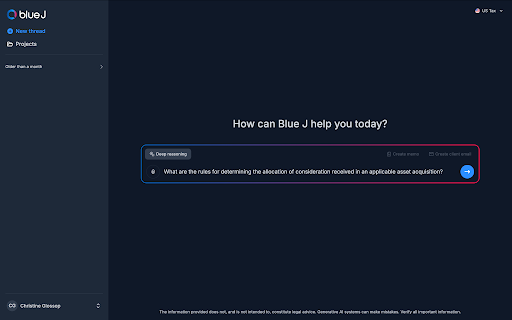
Instead of translating a client issue into a series of keyword or Boolean searches, you can describe the question and relevant facts in plain language.
Blue J provides a conversational tax research experience where you get a synthesized answer with citations to supporting authority.
You can then refine the research through follow-up questions as the issue develops, helping you narrow a broad question without starting a new search each time.
Bring client documents into the analysis when facts are missing
When the answer depends on information buried in a return, agreement, IRS notice, or other client document, you can upload the file and ask questions about its contents.
That lets you investigate missing or unclear facts within the same research process. You can then use what you learn from the document to assess how the additional facts affect the analysis.
Review and compare the authority before settling on a tax position
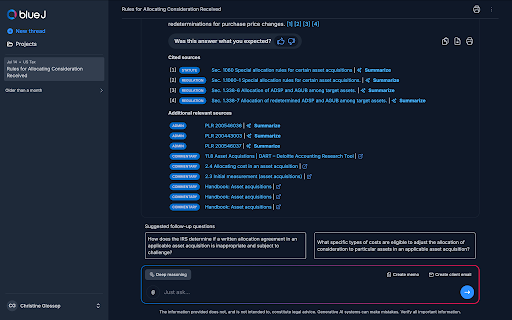
With Blue J, you can compare the relevant sources, consider their legal weight and applicability, and investigate further before reaching a conclusion.
But your professional judgment remains central to deciding which authority supports the client’s position.
Carry reviewed research into the deliverable
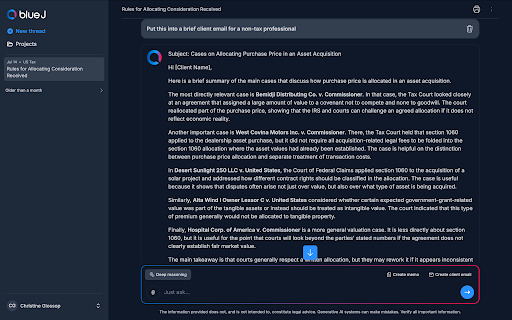
Once you’ve reviewed the authority and reached a conclusion, Blue J’s tax writing capabilities can help turn the research into a draft memo, client email, presentation, or IRS notice response.
The research context carries into the drafting process, reducing the need to recreate the issue in a separate tool. You still review the reasoning, explain uncertainty where needed, and finalize the recommendation for your client.
Frequently asked questions about the tax research process
What are the steps in the tax research process?
The tax research process should follow six steps, including establishing the facts, identifying the issues, locating the authority, checking the authority, developing conclusions and recommendations, and communicating the findings.
This structured approach helps you move from an initial client question to a supported tax position.
What are primary sources in tax research?
The primary sources in tax research include the IRC, Treasury Regulations, administrative guidance, judicial decisions, and tax treaties. These authorities provide the legal foundation for your research and support your final conclusion.
What is the difference between primary and secondary tax sources?
Primary sources provide the tax law and authority you rely on to support a position. Secondary sources explain tax rules, provide context, and help you locate relevant tax authorities during research.
How do tax professionals find relevant tax authorities?
Tax professionals use tax research solutions, like Blue J, and tax law databases to locate relevant authorities. A research plan helps you narrow your search, review supporting sources, and confirm that the authority applies to the client’s facts.
How can AI tools help with tax research?
AI research tools help you find authorities faster, analyze documents, review citations, and support tax writing. When evaluating a tax research platform, consider factors such as source quality, citation accuracy, security, workflow fit, and how easily your team can adopt the tool. A proper evaluation helps you select a solution that supports your research process instead of simply adding another software subscription.
Why is documenting tax research important?
Research documentation creates a record of the facts, authorities reviewed, analysis performed, and conclusion reached. It helps other professionals review your work and supports the position if questions arise later, including in an IRS examination or when showing reasonable cause and good faith to avoid penalties under IRC § 6664(c).

Stay up to date