

Imagine a client is restructuring a business and wants to know how a proposed transaction should be treated for federal tax purposes before filing. As a tax practitioner, your answer may depend on the entities involved, how the transaction is structured, when it occurs, and whether a particular exception or limitation applies.
A single question may require you to move between the Internal Revenue Code (IRC), Treasury Regulations, IRS guidance, court decisions, and secondary commentary before reaching a defensible conclusion.
In this article, we’ll walk you through how to conduct federal tax research from start to finish, the major challenges tax practitioners often encounter along the way, and the research tools that can make the process more efficient.
How to conduct federal tax research from start to finish
Federal tax research is easier to manage when you follow a clear process. Here’s a step-by-step guide on how you can conduct your next federal tax research from start to finish:
Step 1. Establish the relevant facts
Start by getting a clear picture of the facts surrounding your client’s or organization’s situation. This includes the other parties involved, the transaction, timing, ownership structure, goals, future plans, and any other details that could affect the federal tax treatment.
At this stage, you need to ask the following questions:
- Who is involved? Identify the taxpayer and all relevant parties. Determine tax classification and residence, place of organization, worker status, ownership, related-party relationships, and relevant elections.
- What happened or is being proposed? Understand the transaction or event that created the research question—like a proposed merger.
- When did or will it happen? Know when the transaction happened for tax purposes. Timing can affect which rules apply and how the transaction is treated.
- Where did it happen? Understand where the taxpayer is based and where the transaction took place, as location can affect the scope of the research.
- How did it happen? Know the circumstances surrounding the transaction well enough to know which tax rules may apply.
Be prepared to return to the facts as the research develops. Federal tax research isn’t a linear process, and establishing the facts isn’t something you necessarily finish once and leave behind.
Step 2. Identify the tax issues
Once you have the facts, work out the specific tax questions they raise. Sometimes, clients might recognize an obvious tax issue themselves, but a practitioner usually has to identify the issues that sit underneath the fact pattern.
Identify what federal tax questions the facts raise rather than beginning with a broad search of the client's original question. Whenever you encounter a complex tax issue, break the complex problem into smaller issues. A single transaction may raise several tax questions.
When you identify an issue, narrow it from the broad tax question to the specific tax treatment that may apply. Then identify the requirements that must be satisfied under that rule and determine whether the client's facts meet each one. Breaking the issue down this way makes it easier to see which parts require further research and the authorities you need to find.
Step 3. Locate the relevant tax authority
Once you have defined the issue, look for authority that addresses it directly or provides a useful analogy. Start with the governing statute. For most federal tax questions, this is the relevant provision of the IRC.
From there, you can expand the research as needed. Treasury Regulations interpret and implement IRC provisions. IRS administrative guidance and judicial opinions may further explain how a rule applies, but each source must be evaluated under its own reliance and precedential rules.
Legislative history may also help when a statute requires further interpretation, and international issues may require research into applicable tax treaties and related materials.
Secondary sources can orient the research and identify relevant citations, but verify every proposition in the underlying primary authority and update that authority before relying on it. As you find relevant authority, follow where the research leads.
The aim here is to gather authorities that address the issue directly or by analogy. Your research should give you enough context to move on to the next steps.
Step 4. Evaluate and update the authority
Once you’ve found relevant authority, the next step is to evaluate how much weight it carries and how closely it applies to the client's situation. Primary authority can be binding or persuasive.
In this context, binding authority is authority that the relevant court or decision-maker must follow, based on factors such as court hierarchy and jurisdiction. On the other hand, persuasive authority can still help support an analysis, but the court or decision-maker is not required to follow it.
So, finding a source that addresses a tax issue does not automatically mean that source controls the outcome. A precedential decision binding the anticipated forum controls over a conflicting decision from another jurisdiction, even if the latter is more factually similar.
Identify conflicts explicitly. Use a citator and source history to determine whether a case has been reversed or limited and whether guidance has been modified, superseded, or even revoked. Binding precedent from a higher court in the relevant hierarchy controls a lower court; decisions from other circuits are generally persuasive unless the US Supreme Court has resolved the issue.
Step 5. Develop the conclusion and recommendation
Once you’ve identified the issues and evaluated the relevant authority, bring the research together and determine what it means for your client's situation.
At this stage, work through how the applicable law fits the facts, and build the reasoning that supports your conclusion.
Your conclusion should account for the full body of relevant research. This includes statutes, regulations, administrative guidance, judicial decisions, and other applicable authorities you identified and evaluated. It should also address authorities that support your position and those that point in the opposite direction.
Doing this helps ensure that the conclusion reflects the complete legal analysis rather than only the most favorable sources.
Step 6. Communicate the recommendation
Create a tax research memo that presents how you reached your conclusion; it typically organizes the work into facts, issues, analysis, and conclusion.
Some tax research tools can also help with this drafting stage. Instead of drafting a memo and client email from scratch, these tools can help you generate a ready-to-review draft, which you can then edit for the client, audience, and final recommendation.
Major challenges in federal tax research (and how to solve them)
Here are some of the major challenges you should look out for when conducting your next federal tax research:
1. Identifying the right tax issue
Federal tax research rarely starts with a perfectly framed legal question. As a tax practitioner, work through the facts the client or company provided, identify the legal issues they raise, and document material facts that are missing or assumed.
You should also understand your client’s entity type, related-party status, accounting method, timing, taxpayer status, location, and other transaction details. It’s also valuable to keep the client’s goals in mind so you can provide the most accurate advice possible for their unique situation.
2.Finding the right material on time
A single tax issue may require research across the IRC, Treasury Regulations, IRS guidance, judicial opinions, legislative materials, treaties, and secondary sources.
If you’re handling an urgent client question, using a legacy tax research tool can eat into your time. This process often involves trying several search terms, working through long lists of results, opening multiple authorities, and piecing the analysis together before you can give the client a clear answer.
That can leave you spending a large share of your time researching and verifying information instead of focusing on more specialized work, like advising clients. A 2025 EY survey of tax and finance leaders found that internal tax professionals already spend 53% of their time on routine tax activities, compared with just 16% on highly specialized work.
That friction can also contribute to the broader tax research adoption gap, especially when practitioners find legacy tax research tools difficult or time-consuming to use.
On the other hand, AI-powered tax research solutions let you ask tax questions in plain language, get a sourced answer, and check the authority behind the response. In practice, that means less time chasing down information and more time deciding how the law applies to your client’s facts and what position you can support.
This explains why, in our 2026 AI Tax Research Solution Outlook Report, we found that 80% of respondents use either general-purpose AI or tax-specific AI on a weekly or monthly basis.
3. Knowing how much weight to give each authority
Just because a source talks about your issue does not mean you can rely on it in the same way as every other source.
This is because not every source you find will carry the same weight in your research. Some authorities are binding, which means the relevant court or decision-maker is required to follow them. Others are persuasive, meaning they can strengthen your analysis but do not control the outcome.
So before relying on a case, ruling, or other source, check whether it actually governs your client’s situation or simply helps you understand how another court approached a similar issue.
4. Relevant vs controlling authority
A case or ruling can look like a strong match for your client’s situation without actually controlling the outcome. That’s why you need to look at both how relevant the authority is and how much legal weight it carries.
When you review a case, check which court issued it, your client’s jurisdiction, how closely the facts line up, and whether a higher court has already ruled on the issue. A case from another federal circuit may still be useful, but it may only be persuasive. A decision from the Court of Appeals that covers your client’s jurisdiction will usually carry more weight.
For example, say you find a case from another federal circuit that closely matches your client’s worker-classification issue. The case can help you understand how a court approached similar facts, but it may not control your client’s outcome. If your client’s own circuit has ruled differently, that local precedent carries more weight.
5. Dealing with authorities that point in different directions
Federal tax research does not always lead to one clear answer. You may find that a higher court disagrees with a lower court, or that different appellate circuits have taken different approaches to the same issue.
When that happens, focus on which authority actually applies to your client. Look at the court hierarchy and the taxpayer’s jurisdiction before weighing competing decisions. Other cases can still help you understand the issue, but your conclusion should reflect the authority that controls where your client is located, not simply the decision that produces the more favorable result.
6. Ensuring you’re applying the right law to the right tax year
When you’re researching an older transaction, the law you pull up today may not be the law that applied at the time. So before you rely on a provision, check when it took effect, whether it was later amended or expired, and whether any transition rules changed how it applied. You may also need to look at an earlier version of the IRC.
The same goes for older cases. If a case cites an IRC section you don’t recognize, don’t write it off straight away. The section may simply have been renumbered. Trace it forward and check whether the underlying rule actually changed before deciding whether the case still matters.
Legacy tools vs. generic LLMs vs. AI-powered tax tools: Which one is the best?
Legacy tax research tools
Legacy tax research tools—like Thomson Reuters Checkpoint, CCH AnswerConnect, and Bloomberg Tax—are often built around extensive libraries of primary authority, editorial analysis, treatises, tax news, and other professional content. They can rely on traditional workflows that heavily use keyword, citation, Boolean, or filtered searches, followed by reviewing and comparing the relevant documents.
One major downside is that using these tools requires you to know the right type of keyword and spend considerable time refining searches. Finding the right material may require opening several sources and working through the authorities before reaching a conclusion.
When a research tool requires you to know the right keywords and know your way around the database, not everyone on your tax research team will use it the same way. Practitioners who use it often may become very comfortable with it, while occasional users may struggle to get value from the tool.
Generic LLMs
Generic LLMs—like ChatGPT, Gemini, and Microsoft Copilot—let practitioners ask questions conversationally, summarize information, explore unfamiliar concepts, and get an initial understanding of an issue. They are designed for a broad range of tasks rather than specifically for professional tax research.
Their answers aren’t necessarily grounded in a dedicated library of current tax authority. This means that they can produce incorrect or fabricated information.
When using these tools for federal tax research, there is a material risk of relying on outdated, incomplete, or non-authoritative information, especially in a field where accuracy and up-to-date authority are critical.
AI-powered tax research solutions
AI-powered tax research solutions combine conversational research with tax-specific content. You can ask questions in plain language, get synthesized answers tied to relevant sources, ask follow-up questions, and review the underlying authority as your research develops.
Many tax teams and firms are adopting tools that leverage generative AI in tax research to make their research process more seamless.
One thing worth comparing closely between these solutions is source coverage. Different tools may cover different jurisdictions, types of primary authority, and secondary commentary. They may also source and update that content differently. For you as a tax practitioner, those differences can affect the kinds of questions a research solution can support and the authorities it can draw on when answering them.
Blue J, TaxGPT, and Accordance are examples of AI-powered tax research solutions. With Blue J, you can ask tax questions conversationally and receive answers backed by a curated tax-content library, with inline citations and source lists that take you back to the supporting authority.
Blue J combines primary tax authority with trusted secondary content. The solution’s Tax Notes integration adds tax news, analysis, and commentary, while its IBFD partnership gives you access to specialized international tax research. Additionally, you can add client documents and keep the research going with follow-up questions.
Streamline federal tax research with Blue J
Federal tax research can quickly turn into hours of searching, opening documents, comparing authorities, and pulling the analysis together. Blue J helps shorten that process by bringing research, source review, and drafting into one workflow.
Blue J serves tax professionals across four main audiences:
- Sole practitioners and local firms: Blue J helps independent professionals research complex or unfamiliar issues faster. They can also review the sources behind each answer before moving forward.
- Mid-market accounting and tax firms: growing firms can use Blue J to make research faster and more consistent. It also gives teams an easier way to work through complex tax questions together.
- Large accounting and advisory firms: Blue J helps larger firms manage a high volume of complex research. Teams can review supporting authority and spend more time applying professional judgment.
- Corporate tax departments: in-house teams can use Blue J to research federal, state, international, and transactional tax issues. This supports work across compliance, planning, audits, and internal decision-making.
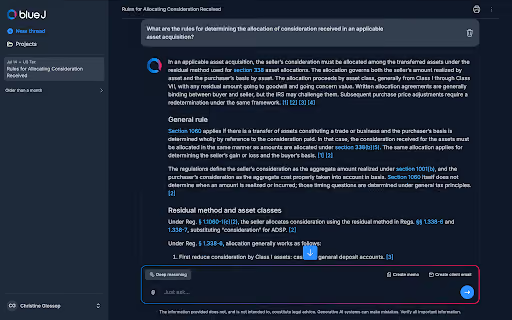
With Blue J, you can:
- Ask tax questions in plain language: start with the issue you need to research instead of first building Boolean searches. This conversational tax research approach makes it easier to begin with the client’s actual question.
- Get sourced answers you can review: Blue J provides synthesized answers with inline citations and source lists, so you can open the underlying authority and check what supports the response.
- Keep digging with follow-up questions: as new issues come up, you can continue the research without rebuilding your search from scratch.
- Go deeper into individual sources: Ask a Document lets you question and analyze cases, rulings, regulations, and other source material directly.
- Bring your client’s facts into the research: add documents such as returns, agreements, and notices to help research how the law applies to the facts in front of you.
- Turn research into a usable draft: once you reach a conclusion, Blue J can support tax writing, including tax memos, client emails, and responses to IRS notices.
- Advisory research: explore complex tax questions and planning issues while keeping the supporting authority close at hand.
Using Blue J for your next federal tax research helps you spend less time hunting through search results and stitching sources together.
Frequently asked questions about federal tax research
What is the difference between primary and secondary tax authority?
Primary tax authority includes sources such as the IRC, Treasury Regulations, IRS guidance, and court decisions. Secondary authority, such as treatises and editorial commentary, can help you understand the issue and point you toward relevant primary sources, but it does not bind a court or the IRS.
How do you determine which federal tax authority controls?
Start with the type of authority, then look at court hierarchy and your client’s jurisdiction. For example, a decision from the Court of Appeals that would hear your client’s case will generally carry more weight than a conflicting decision from another circuit.
How do you know if a federal tax authority is still valid?
Before relying on an authority, check whether anything has changed since it was issued. Look for newer statutes, regulations, IRS guidance, and court decisions, and use a citator to see whether a case has been reversed, overruled, or otherwise affected.
Can older federal tax cases still be relevant?
Yes, age alone does not make a case obsolete. Before relying on it, ensure you use a citator to confirm it has not been overruled, reversed, or otherwise treated negatively. You should also check whether the IRC section it relies on has since been renumbered—if so, trace the IRC section forward.
How can AI be used in federal tax research?
AI-powered tax research solutions can help you ask federal tax questions in plain language, find and synthesize relevant authority, ask follow-up questions, and review supporting sources faster. In addition to tax research, some AI tax solutions can also assist with tax writing, turning your research findings into tax memos, presentations, client emails, and responses to IRS notices.
However, not all solutions are built the same way. So when you want to evaluate AI tax research tools, you should consider the quality of sources, research coverage (does it include federal tax, international tax, or SALT), and how often their content gets updated.

Stay up to date







.webp)
