

2026 AI Tax Research Solution Outlook Report
How accounting firms are shifting from trying AI to relying on it—and what this means for the future of the profession
Foreword
The tax profession has reached an inflection point.
For years, AI in tax research was treated as something to watch, test, or cautiously pilot. That period is ending. The findings in this report show a profession moving from curiosity to reliance. Firms are no longer asking whether AI-powered tax research belongs in the practice of tax. They are asking how to build around it, govern it, train with it, and use it to deliver better advice.
That shift matters because tax research has always been at the center of the profession’s value proposition. Clients do not come to tax professionals merely for information. They come for judgment. They come for the disciplined application of law to facts, for the ability to distinguish what is technically possible from what is prudent, and for advice that accounts for risk, timing, economics, and human context.
AI changes the mechanics of that work, but not its purpose.
When AI-powered tax research is used well, it reduces the friction that has historically consumed so much time: finding the right sources, synthesizing complex rules, checking for current authority, and moving from question to answer. The highest-value outcome is not speed. It is the reallocation of human attention. Time saved on research mechanics becomes time spent understanding the client, testing assumptions, weighing alternatives, and communicating advice clearly.
That is why the most important story in this report is not automation. It is professional elevation. Seventy-seven percent of regular users say AI-powered tax research gives them more time for work that better leverages their professional judgment. That is exactly where the profession should be heading.
The future of tax will not be defined by humans competing with machines to retrieve information. That was never the best use of professional talent. The future will be defined by professionals who combine technical expertise, strong judgment, and client trust with tools that make the underlying knowledge base more accessible and actionable.
That future also requires leadership. Firms cannot treat AI adoption as a procurement decision alone. They need thoughtful implementation, clear standards, training, quality control, and new operating models. They need to decide how AI-enabled efficiency should affect staffing, pricing, client service, and professional development. They need to ensure the next generation of tax professionals learns not only how to find answers, but how to ask better questions, evaluate outputs, and deliver advice clients can act on with confidence.
At Blue J, we have long believed that AI should make tax professionals more capable, not less central. This report reinforces that belief. The rise of AI-powered tax research is not the end of practitioner judgment. It is an opportunity to put that judgment where it belongs: at the center of the client relationship.
Benjamin Alarie, Founder & CEO, Blue J
Executive Summary
How accounting firms approach AI-powered tax research has changed significantly over the past year. In 2025, AI adoption was showing signs of serious momentum. In 2026, we haven’t just reached a tipping point for adoption—we’ve passed it.
As firms move from experimenting with AI-powered tax research to embedding it across core workflows, this shift from “trying to relying” is changing more than just how tax work is done. It’s changing what the accounting profession looks like altogether.
In order to understand the nature of this shift, Blue J and CPA.com partnered to create the 2026 AI Tax Research Solution Outlook Report. This report brings together Blue J’s expertise as an AI-powered tax research solution provider and CPA.com’s knowledge in equipping firms with the tools, research, and practice enablement strategies they need to thrive. By combining both perspectives, the Outlook Report provides a look into how AI is changing the way firms operate, as well as practical strategies for firms to make the most of their own AI transformations.
Backed by survey data collected in the spring of 2026 from 1,000 US-based accountants1, the report’s findings point to something unexpected about the AI-enabled future of tax: there’s a human element at the core of this technological shift. From deepening client relationships to placing a greater emphasis on practitioner judgment, firms are increasingly prioritizing human experiences and the uniquely human skills AI can’t replace. As AI adoption becomes table stakes, the firms that thrive will be the ones that adapt to make their practices more human.
Note:
1. Respondent demographics differed from the previous year’s survey population. As a result, year-over-year comparisons should be interpreted accordingly. Please see the Appendix for more information.
Key Findings
#1: AI-Powered Tax Research Adoption Is Past the Tipping Point
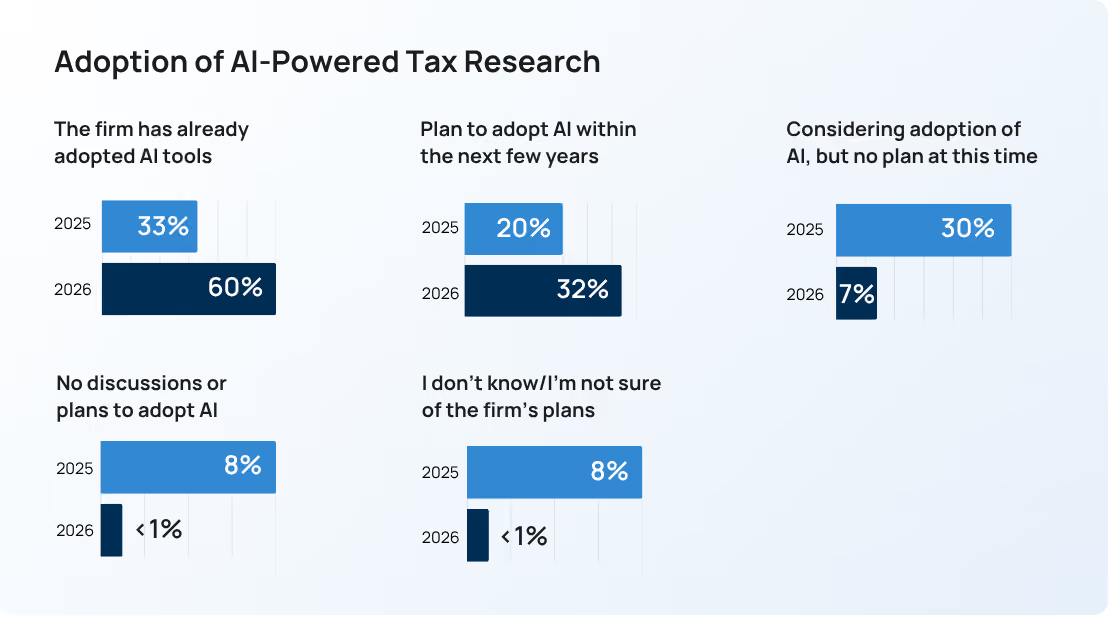
The majority of respondents’ firms have now adopted AI-powered tax research. While only 33% reported working for firms that had adopted AI-powered tax research in 2025, that number has nearly doubled to 60% in 2026. At the same time, the percentage of firms considering adoption in the near future has also grown, rising from 20% to 32%.

What it means: “Practitioners are finding that there's a better way to work,” explains Brandon Allfrey, CPA, Senior Director of Tax Transformation at CPA.com. The efficiency gains from using AI to power tax research are freeing up time for higher-value work. “They’re getting the opportunity to speed up the things that have taken a tremendous amount of time and to get narrowed down on better answers faster.”
What to do next: “It takes a mindset shift,” Allfrey adds. “Previously, the work model for tax research and preparation was to get client details and questions, then spend a whole lot of time in those details before you could spend real time advising clients. AI changes that whole way of thinking about how to serve the clients. You're able to spend more time on building the client relationships because you're not having to spend the time doing all the research and preparation work. With that, you can’t just subscribe to an AI-powered tax research tool and call it a day. You need to figure out how you're going to use it to build a relationship with clients so they trust you for everything.”
#2: AI-Powered Tax Research Is Now Embedded Across Workflows
As for where practitioners are using AI-powered tax research, those respondents who had adopted AI cited a wide variety of workflows in which they’re leveraging the technology. At the top of practitioners' extensive list of applications for AI are advisory-related workflows, with advisory projects (44%) and tax planning (40%) coming out ahead.

What it means: “In the past, tax research tools were very specific,” Allfrey says. “They could do one thing for you. But we’re at a point now where we can apply them to all these different areas. As a result, firms are getting exponentially greater return on investment from these tools but also a greater return on the time they spend using these tools. And that return on time again comes back to being able to better serve clients.”
What to do next: In order to achieve these exponential gains, Allfrey suggests thinking in systems rather than tasks. As he explains, “The real power comes when you systematize how these tools are used, building processes that let you get a better picture of the client as a whole, rather than just researching one question at a time. In a good system, your tax research tool is touching planning, it's touching review, it's touching preparation, and it's touching advisory.”
#3: AI-Powered Tax Research Is Changing Accounting’s Relationship with Time
Across these various workflows, AI is helping accountants save time. Time saved remains one of the top advantages of using AI-powered tax research, with 83% of respondents citing it as a key benefit in 2025 and 84% citing it in 2026.

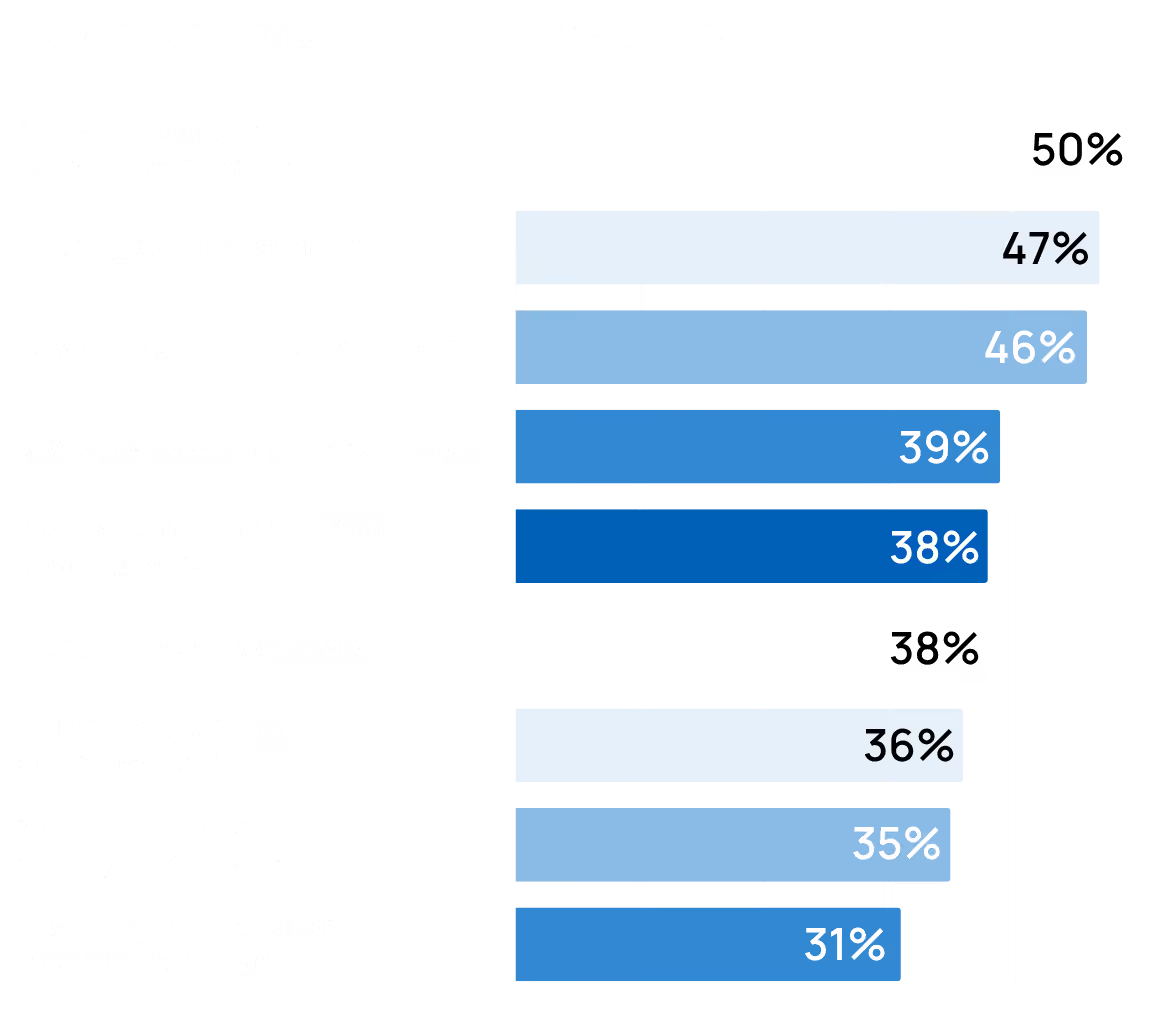
This year, we also set out to understand exactly where that saved time was going. Among the 84% of respondents who believe AI saves time, most said they’d put their recovered bandwidth toward people—creating better experiences for both staff and clients. Half (50%) of the survey participants cite improving client response and project delivery timelines as areas they do or would want to put that saved time, while 47% say they’d put it towards improving work-life balance for staff, and 46% say they’d use it to deliver higher-quality advice to clients.
What it means: “One of the worst things firms could do when looking at AI-driven time savings is try to just do more work,” says Allfrey. “Firms have a real opportunity to be thoughtful and deliberate about how they use this time and giving time back to staff is one critical area to start. There’s been a lot of discussion about recruitment and retention in the past few years and one really easy way to keep your people is to just not burn them out.”
What to do next: “The best talent follows the firms that will use the best tools and the best applications of those tools,” Allfrey adds. “Because staff know which tools will allow them to have more time for a life outside of work. It’s all well and good to implement rules limiting hours during busy season, but you need the processes and tools that will actually make that possible as well.”
#4: AI-Powered Tax Research Changes How Accountants Charge for Work
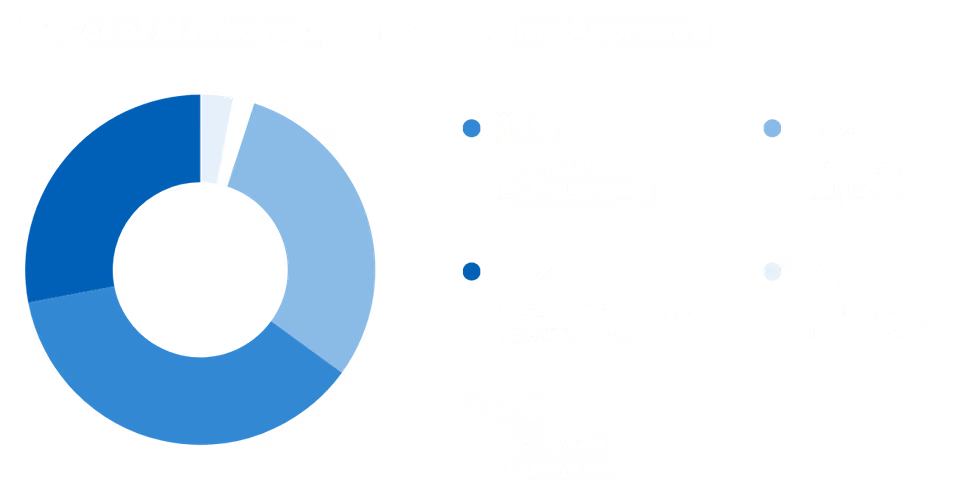
In a profession that’s long been defined by the billable hour, time savings also come with some financial considerations. As they look to adapt their billing to better match the pace of AI-enabled workflows, 69% of AI adopters are considering alternatives such as value-based, hybrid, and fixed-fee billing.
What it means: For Allfrey, these billing changes put the true value of accounting services in the spotlight. “In a lot of ways, this shift is acknowledging something that’s always been true in the profession,” he says. “Clients aren’t paying for the time it takes to do something right now, they’re paying for the sum of experiences over your career. That said, changing billing to reflect that is still a massive change management challenge. Hourly billing is just so entrenched in the profession. Finding a new billing model that works for your firm and then actually implementing that model is very difficult.”
What to do next: “The firms that I see succeeding in transitioning their billing model are the ones that are willing to try things out,” Allfrey continues. “Taking a subset of your clients to try out a new billing model and running it like an experiment, that lets you see what is and isn’t going to work for your firm. Rather than thinking of it as a wholesale change you have to do all at once, you can almost run it like a beta test, trying things out and adapting as you go.”
#5: AI-Powered Tax Research Frees Up Practitioner Judgment
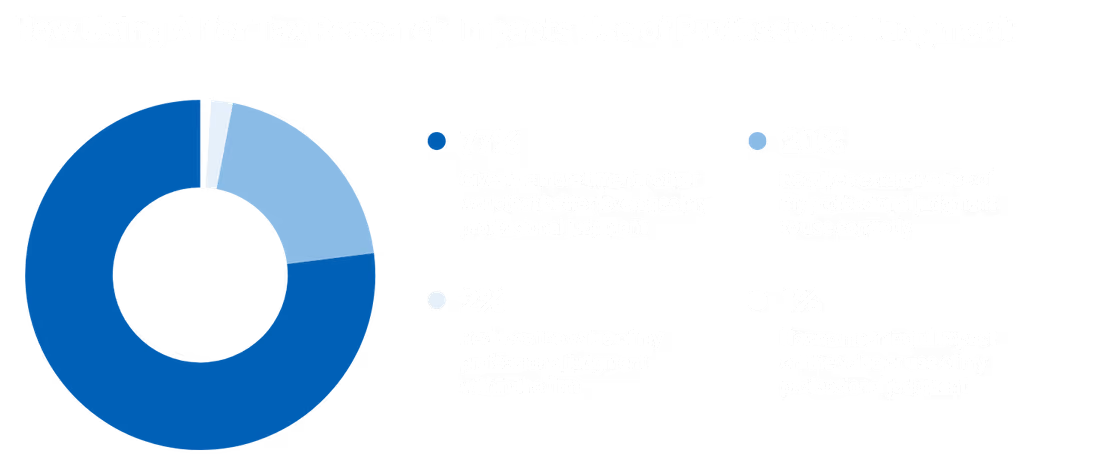
Time isn’t the only thing AI-powered tax research is freeing up. When asked about how these tools affect their professional judgment, respondents overwhelmingly saw the technology as freeing up the headspace necessary to use that judgment. Of the respondents who have adopted AI-powered tax research, 77% say it gives them more time to do work that better leverages this aspect of their expertise.
What it means: “People come to a CPA because they have a level of trust already with them,” explains Allfrey. “But it's really easy when you're working with a lot of clients to fall into giving prescriptive answers that don’t always take into account a client’s full situation. Having more time to use your professional judgment means spending more time thinking about the client individually. And the more that you can spend your time personalizing the message to them, the more trust you build.”
What to do next: “This is bigger than just adopting AI-powered tax research,” Allfrey says. “It’s one part of the larger tax transformation process where across the board we’re standardizing and automating where it makes sense, so that we can put more time towards judgment. When you do this right, you're giving more value than you've ever given before just because you finally have the time to do so.”
At a Glance
Taken together, these findings point towards an important shift in the accounting profession. As AI-powered tax research becomes more deeply integrated across workflows, it can take on a larger portion of those time-intensive tasks accountants have historically been burdened with. And with less time going to these tasks, more can go towards fostering client relationships and leveraging judgment to provide those clients with better advice. Rather than replacing accountants, AI acts as a complement, allowing practitioners to hone the uniquely human skills AI can’t replace—to become the trusted advisors clients need.
Trends in Overall AI Adoption
The rise of AI-powered tax research is just one part of a much larger trend in increased AI adoption across industries. McKinsey’s most recent State of AI report found that use of AI in at least one business function rose from 78% in March 2025 to 88% in November 2025.

When narrowing the view slightly to just financial services organizations, Deloitte saw a similar pattern of growth. Within the financial services industry, organizational adoption of AI tools nearly doubled YoY, rising from 30% to 62%. Here too, the shift from trying to relying is also clear, with 53% of respondents expecting 40% or more of their AI experiments to move into production within the next three to six months.

As AI adoption continues to accelerate across industries, a new class of agentic AI is beginning to reshape what organizations expect from these tools. Rather than supporting discrete tasks, these systems can plan, execute, and iterate on complex workflows with minimal human intervention—effectively acting as what McKinsey refers to as “virtual coworkers”. These virtual coworkers are already showing promise in transforming the impact of AI in organizations from simple point solutions, which swap out a human for AI on a particular task, to systems solutions, which reimagine what workflows look like altogether.
Already, the cross-workflow integration of AI-powered tax research is showing what deeper integration of this technology can mean for organizations and their people—taking on a larger portion of automatable tasks and giving practitioners time back for their uniquely human contributions.
AI-Powered Tax Research Adoption Trends
Comparing AI-powered tax research adoption data from 2025 and 2026, there’s an obvious shift from consideration to commitment. The percentage of firms that have already adopted AI for tax research has almost doubled, while the percentage still considering it without a clear plan has decreased significantly. Inaction around adoption is negligible, suggesting that AI is now firmly on the strategic agenda for almost all respondent firms.
For Tim Robertson, Senior Accountant at Pearce, Bevill, Leesburg, Moore, P.C., a Birmingham, Alabama-based firm, the tipping point could no longer be avoided. "When we were looking for an AI solution, it was time for the firm to adapt,” Robertson recounts. “Technology increases—AI is here and it's not going anywhere. And so we needed a new tool to assist our work as well as to think about how we can better add value for our clients."
What firms once saw as an experiment, they now see as an essential technology for the accounting profession. And as more and more of their counterparts make the move, the counterargument against adopting AI becomes harder to make. If your firm isn’t using AI to add value for clients, another firm will.
AI Usage Trends
Firms having access to AI for tax research is one thing. Accountants using AI for tax research is another thing entirely. Similar to our findings from last year, the percentage of respondents who report using AI for tax research is larger than those who report working for firms that have formally adopted AI for tax research.
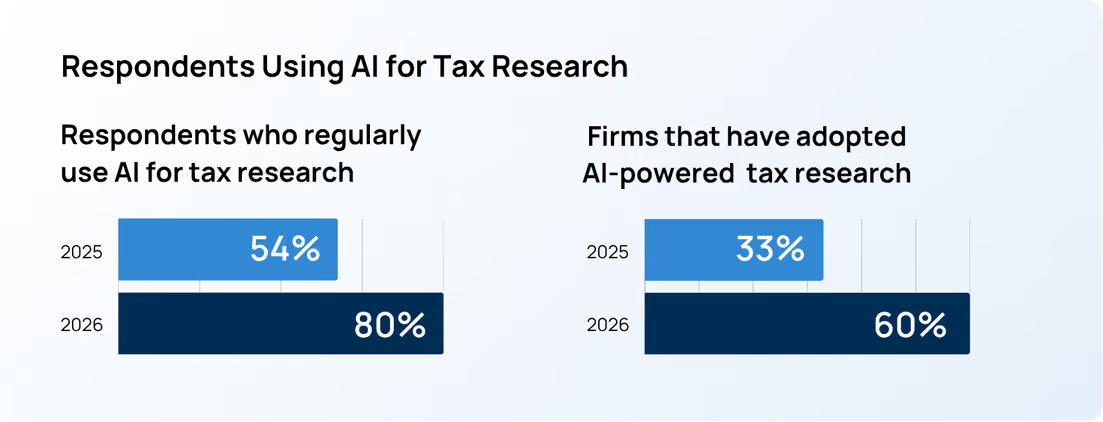
In last year’s report, 54% of respondents reported regularly using some form of AI. This year, 80% of respondents report using either general-purpose AI or tax-specific AI on a weekly or monthly basis. Recalling that only 33% of respondents in 2025 and 60% of respondents in 2026 work for firms that have formally adopted AI for tax research, there’s an obvious gap here. This gap points toward possible unsanctioned AI usage within firms, where employees are leveraging the technology without their firm’s approval.
This unsanctioned AI usage can pose a threat to firms, as general-purpose tools aren’t specifically trained for tax and don’t have access to all the necessary tax content sources. Incomplete sources can lead to inaccurate or outdated answers, which can put clients at risk of making dangerous tax decisions. But rather than trying to stamp out AI usage, firms would be better off redirecting it by adopting tax-specific AI tools. The clear preference practitioners have for AI tools means that your firm isn’t choosing between having AI for tax research or not having AI for tax research. You’re choosing between having sanctioned AI usage and having unsanctioned AI usage.
Still, some firms are understandably intimidated about kicking off a complete digital transformation. For those firms, Kevin Sickels, CPA, Tax Department Partner at Ketel Thorstenson, an IPA 200 firm based in South Dakota and Wyoming, offers a simple approach. “You do not need a full digital transformation team to roll out firm-wide adoption,” he says. “By taking a phased approach, you can figure out what really works for your firm and put the right policies and best practices in place as you grow, making the whole process so much smoother.”
Testing, learning, and adapting as you go ensures you can make the most of AI while minimizing any risks. A much safer approach than letting shadow AI usage go on unchecked.
The Current Toolkit
Expanding our view beyond AI alone, we also asked survey respondents about their overall tax research toolkit. As with last year’s Outlook Report, most respondents have access to multiple tools for tax research.

Here again, access to AI is higher than firm adoption numbers, with a full 90% reporting access to general-purpose AI for tax research. Tax-specific AI tools fall much further down the list, with only 46% reporting access. Considering the sheer accessibility of general-purpose AI tools, this difference is in many ways expected. When you already have access to general-purpose AI tools for other areas of your work or personal life, using that existing account for tax research is easy enough. Especially for those 67% of respondents who have access to notoriously difficult-to-use traditional tax research tools, the temptation can be too great to resist at times.
Legacy Tax Research Tools: Built for a Pre-AI World
As firms move from trying AI-powered tax research tools to relying on them, where does that leave the legacy solutions that once defined the tax research category? More and more, the way of working required by legacy tools is at odds with what tax experts want. Even if they don’t yet have access to AI-powered tax research themselves, the growing ubiquity of this technology shapes user expectations.
Legacy tools were built to surface sources that matched keywords, leaving practitioners to stitch these sources into a comprehensive response. With AI-powered tax research solutions producing comprehensive answers from conversational prompts, the already clunky process of traditional tax research now feels entirely out of place.
While many of these legacy tools are starting to offer AI add-ons, these often fail to fix the issues of their underlying systems. Because these add-ons have been layered on top of content-first legacy solutions, they can help users more easily access content, but they don’t meaningfully change the research workflow. The answers they generate are often only simple source summaries, leaving practitioners to create multiple follow-up prompts and toggle between products just to arrive at the same quality of answer an AI-powered tax research solution can generate in seconds.
With a poor user experience slowing them down, you can hardly blame accountants for turning to unsanctioned AI tools—even if doing so risks research accuracy.
Motivations Behind AI Adoption
The decision to adopt AI-powered tax research doesn’t come from nowhere. But when we asked those respondents who report regularly using AI for tax research why they’ve adopted this technology, the top motivations came as somewhat of a surprise. Looking through the specific challenges and opportunities that led respondents to adopt AI-powered tax research tools, their answers are notably human-focused:
- Looking for more efficient ways to train new team members (45% strongly agree)
- Keeping up with client expectations (41% strongly agree)
- Focusing on upskilling people/teams (40% strongly agree)
In brief, the strongest motivations for adopting AI for tax research center around creating better experiences for teams and clients. When it comes to what exactly those improved client experiences look like, Matt Brewer, CPA, Tax Partner & National Tax Software and Automation Leader at Sorren, an IPA top 100 public accounting and advisory firm, offers some perspective. "The evolution of the client expectation going from a compliance-only to more of a trusted advisor—it's been a gradual move,” Brewer says. “Now, all your clients are really looking for that trusted advisor, as opposed to just the top tier that you were servicing in the historical model."
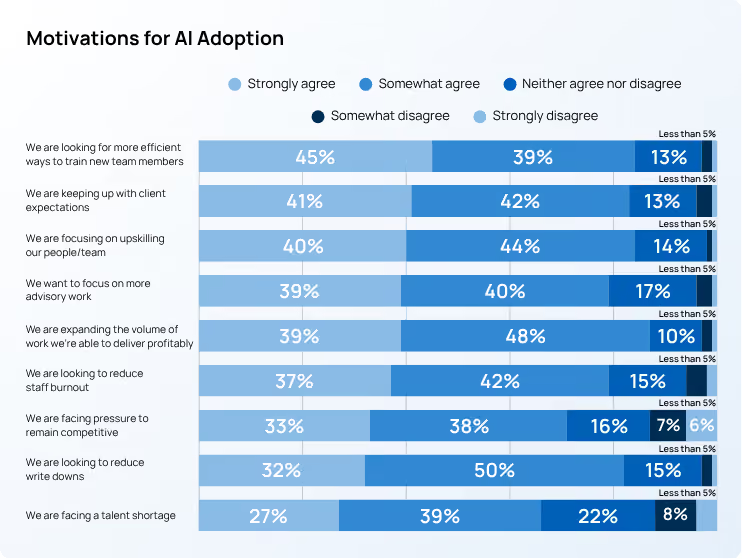
When we factor in both “somewhat agree” and “strongly agree” responses, the top motivations become more financially-focused. For example, while only 39% of respondents strongly agree that expanding the volume of work to deliver profitability is a reason for their AI adoption, that figure rises to 87% when including somewhat agrees. Similarly, while only 32% of respondents strongly agree that looking to reduce write-downs is a motivation, 82% agree overall. This may suggest that even if respondents are aware of the financial motivations for adopting AI-powered tax research, they don’t feel these motivations as strongly as they do the more human ones.
Of course, there are financial knock-on effects to having more skilled staff and happier clients. As Matt Brewer sees it, better client experience is a retention play. "Being able to do that research quickly and get back to them is ultimately what clients have come to expect,” says Brewer. “And it’s what they need in order to feel the confidence that you're the right fit for them going forward."
But even if retention is the goal, client experience still comes first. In order to build client relationships that last, you need to start with the person sitting across from you.
AI Integration Across Workflows
Zooming in from adoption to actual usage, we find respondents have incorporated AI-powered tax research across a broad variety of applications. Rather than any one particular workflow having a clear lead, responses only ranged by about 16 percentage points. This assortment of workflows where AI-powered tax research has been implemented indicates a maturity to the state of AI adoption within firms.
Because many firms begin implementing a new technology with more limited pilot projects, seeing AI-powered tax research used for so many different workflows indicates that respondents have moved beyond the pilot phase. They’re not just trying this technology anymore. They’re relying on it. With that reliance, firms can start to see the benefits not just of point solutions but of systems solutions, which compound as AI is implemented across multiple applications.
Kristina Stamatis, CPA, Partner at upstate New York-based firm MMB+CO, offers further perspective on what cross-workflow AI integration looks like for her firm. As she explains it, “We are using Blue J every day. I would say the people in my office have it open on their desktop almost every day.”
While AI-powered tax research serves as a constant companion at MMB+CO, there’s one workflow category where it stands out: advisory. As Stamatis explains, "At this point in my career, and as the market has changed, I focus mainly on advisory services—lots of projections and planning, succession planning, buy/sell agreements, M&A work. So I get to do a lot of the fun stuff."
Notably, the top two most popular applications cited by respondents were advisory-related, with 44% of respondents leveraging AI-powered tax research to work on forward-looking advisory projects and 40% using it to proactively identify tax planning opportunities. The prominence of these advisory workflows follows the larger trend in accounting towards taking on more advisory-related work.
AI: Advantage or Essential?
The level of cross-workflow integration we saw with respondents may also help to explain a somewhat unexpected finding from our survey. As AI-powered tax research becomes more deeply integrated across firm workflows, it also becomes more essential to the firm’s overall function. Of the AI adopters we surveyed, 70% now consider AI-powered tax research very or completely essential to their workflows.


At the same time, the percentage of respondents who consider AI-powered tax research to be an advantage has dropped between 2025 and 2026—going from 87% to 80%. As firms integrate AI-powered tax research more deeply, adoption alone is no longer an advantage. Now, firms need to differentiate themselves by how their teams use this technology, not simply if they use it.
Building workflows where AI and humans can work in complement allows firms to play to the strengths of both. This especially applies to advisory-related workflows, something Stamatis has already found an effective balance for at MMB+CO. As she puts it, "The use of Blue J and AI really has allowed us to spend the time developing a more strategic relationship with our clients and advising our clients on the things that matter, rather than spending so much time on technical research."
While AI excels at the more technical aspects of research, it’s still up to the practitioner to turn those findings into meaningful advice and then deliver that advice to clients. AI-powered tax research can help accountants to become trusted advisors, but it can’t act as a trusted advisor on its own.
From Experimental Tool to Essential Technology
At Blue J, we’re witnessing the rise of AI-powered tax research firsthand. As more and more firms make the move, AI-driven workflows are increasingly the standard way in which tax work gets done.
- 9,000,000+ Questions answered
- +388% YoY growth in questions answered from March 2025 to March 2026
- 5,000+ Organizations using the platform
- +25% Increase in daily usage from March 2025 to March 2026
- +730% Increase in questions incorporating client files from October 2025 to March 2026, reflecting new workflows leveraging the platform
- 79% Of users rely on Blue J for client-facing outputs, such as emails and memos
AI Is Changing Accounting’s Relationship with Time
Regardless of which workflows we’re talking about, there’s one central benefit that dominates most discussions of AI: efficiency. It should come as no surprise then that time saved is among the top benefits cited by both AI adopters and non-adopters alike.
- 84% agree AI saves time
- 84% agree AI simplifies/helps interpret complex tax rules
- 83% agree AI makes it easier to stay up to date on the latest tax issues
Considering how time-consuming tax research has traditionally been for accountants, making things faster solves a central pain point for the profession. For Kristina Stamatis at MMB+CO, the impact of AI-driven time savings is clear: "Time is our biggest hurdle in this industry. There's never enough time in the day to serve our clients the way that we want to.”
But with speed coming out as a top benefit of AI-powered tax research, this finding brings with it a question. Where does all that time actually go? If AI saves so much time, what are accountants doing with that reclaimed time?
As with the triggers for adopting AI, the ways in which accountants redeploy AI-driven time savings are strikingly human. Of the 84% of respondents who agreed that AI saves time—which includes both AI adopters and non-adopters—here’s where they said they do or would redeploy AI-driven time savings:
- 50% Towards improving client response and project delivery timelines
- 47% Towards improving work-life balance for staff
- 46% For delivering higher-quality advice to clients
While the typical narrative around AI adoption sees time savings as a way to simply take on more work, our respondents largely saw it as a way to make work better. Client and employee experiences take precedence over more financially-focused time redeployments. Of particular interest are the 47% who said they would or do redirect AI-driven time savings towards improving work-life balance for staff. In a profession that’s long been plagued by burnout, AI appears to be a possible solution.
Joe Fullerton, CPA, Tax Partner at Sorren, acknowledges just how bad the problem has become at firms, saying, “Unfortunately, we all did it—and it's the old fraternity hazing analogy where I got hazed, so everyone else deserves to get hazed. I think we need to quit hiding behind that and embrace the fact that maybe the 40 or 45-hour week is possible."
Fullerton’s colleague, Matt Brewer, offers some perspective on how AI is taking work-life balance from promise to reality at the firm. "This industry's talked a lot about work-life balance in the past, but it didn't get much beyond the conversation, because we hadn't figured it out—we didn't have the right tools to do it,” Brewer explains. “And I do think that AI is going to be a big part of actually being able to have work-life balance in this industry going forward."
Again, just as with respondents’ motivations for adopting AI, there are knock-on financial effects to these more human-focused time redeployments. Improved employee and client retention pays—but not nearly as immediately as those more financially-focused time redeployments found much further down the list, such as taking on a higher volume of work (38%) and adding capacity without adding headcount (36%).
Changing How to Charge for Work
At the same time accountants are considering how to use AI-driven time savings, they also need to consider what these time savings mean for their billing structure. Traditionally, accounting has operated on a billable hour model. Work takes a certain amount of time and firms then charge clients for that time. But when AI can help accountants turn what was once hours of work into minutes, that model no longer holds.
Sorren’s Joe Fullerton shares how his firm has begun grappling with this change. "Historically, the only way we make more money is to get more efficient or we work more time,” he explains. “We sell more time. So now we're getting some of that time back with investments in technology, but I'm not willing to give away all that efficiency via my billing."
In order to balance these newfound efficiencies with the costs of using the technology that enables them, many firms are moving beyond the billable hour. Of the AI-adopters we surveyed, 69% say they’re looking to change their billing structures to value-based, hybrid, or fixed-fee models.
By decoupling time from value, these billing models put the focus more on what it took to arrive at an answer, rather than just how long it took. While part of that shift means accounting for the cost of AI-powered tax research tools in your billing, another part involves accounting for the expertise of those practitioners using them.
As Brandon Allfrey, CPA, Senior Director of Tax Transformation at CPA.com, noted earlier in this report: “Clients aren’t paying for the time it takes to do something right now, they’re paying for the sum of experiences over your career.”
In many ways, a move away from hourly billing brings the true value of practitioner expertise into the foreground. What matters is the individual behind the answer, not just the numbers on their time sheet.
Judgment Matters More Than Ever with AI
Traditional tax research tools made it difficult to access knowledge. Just navigating these platforms was a skill in and of itself, requiring practitioners to craft complex Boolean searches, sift through endless sources, and stitch together answers for clients. Due to their complexity, these tools effectively made the practitioners who could use them gatekeepers of knowledge.
With AI-powered tax research, knowledge is now more accessible. As such, a firm’s value increasingly lies in how it helps clients apply that knowledge, translating complex rules into clear options, outlining practical implications, and supporting decisions with well-grounded, actionable guidance. So that judgment—not knowledge—is now the differentiating factor for practitioners.
But AI isn’t just making judgment more important. It’s also enabling tax practitioners to leverage it more effectively. For Matt Brewer at Sorren, this change is already becoming evident in the firm. "I'm starting to see that AI is allowing the profession to focus more on the judgment side of things and build those client relationships,” Brewer says. “The clients are starting to look more for that trusted advisor—somebody that can say, 'Hey, I'm thinking about selling—what do you think we should do here? Should I look into doing a 1031 exchange?'"
Fellow Sorren team member, Joe Fullerton, agreed with this sentiment, particularly the ways in which AI allows practitioners to be more proactive in how they advise clients, saying, "Using AI allows me to be on offense more than defense now."
Respondents to our survey feel similarly about AI’s impact on enabling judgment. Among those who regularly use AI for tax research, 77% say it gives them more time for other work that better leverages their professional judgment.
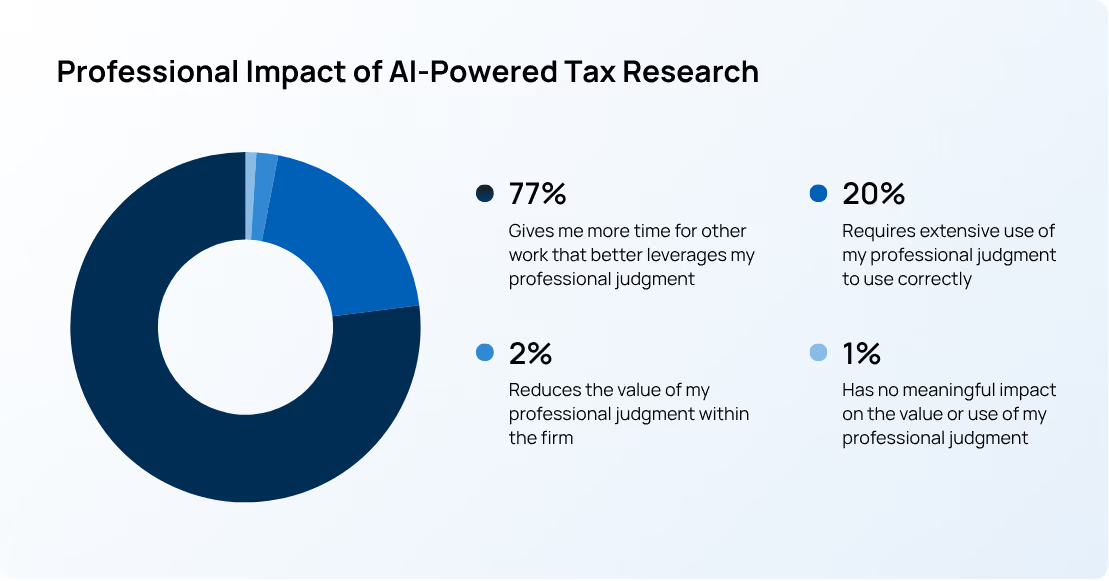
With the algorithm handling the heavy lifting on research, practitioners have both the tools and time to use their professional judgment. As a result, clients get better advice, while practitioners get to work on more engaging and professionally-fulfilling problems.
AI and the Changing Role of Tax Practitioners
As we’ve noted throughout this report, AI-powered tax research adoption has matured significantly in the past year. The story now is no longer one of adoption, but of how firms adapt to the AI-enabled future of accounting. And one way we’re seeing them respond to this technological shift is by focusing on the human side of the profession. In the face of increased automation and efficiency, those uniquely human contributions have become more important—not less.
Whether through reinvesting saved time into fostering client relationships or refocusing their efforts on judgment-centric advisory work, accounting firms are establishing a whole new way to work. This simultaneous emphasis on supporting client relationships and leveraging judgment changes more than just what day-to-day work looks like for accountants today. It also changes how they need to train the next generation.
Here, Brandon Allfrey from CPA.com offers a vision of what this new approach to training can look like. “There are three levels of training that need to happen,” he explains. “One, they still need to be technically proficient so that they can look at what comes back out of an AI tool and know if it makes sense. The second level is that they've got to have those cognitive skills, to be able to ask the right questions. Then the third level is the total human skills. This is about how to approach people, how to talk to people face to face, and how to deliver advice.”
Whereas firms previously focused on training for technical skills, this approach prepares them for the realities of that trusted advisor relationship clients are coming to expect. When clients expect a high-touch relationship that provides continuous strategic advice, firms need to prepare staff to deliver on those expectations from day one. Rather than simply accumulating judgment and people skills over years of practice, firms need to actively train for these skills.
Together, Allfrey believes these three levels of technical, cognitive, and social skills can equip the next generation to truly act as trusted advisors to their clients. “It’s the perfect combination, where you have those technical skills, but also judgment skills and client relations skills,” he adds. “AI can help you with some parts, but certain skills are non-replaceable and uniquely human.”
The Opportunity in AI-Powered Tax Research
As AI continues to advance rapidly, it’s understandable for tax practitioners to feel a bit worried about the future. In the span of just a few years, AI-powered tax research has gone from an experimental technology to a cross-workflow essential. With that surge in adoption, the overall shape of the profession is changing. Along with that change comes opportunity. For the firms ready to seize this opportunity and adapt to the AI-enabled future of tax, the effect can be transformative. They can:
- Attract top CPA talent with a better toolkit and better work-life balance
- Perform research faster and more easily, without sacrificing quality or accuracy
- Create more headspace for the judgment-focused thinking that advisory work requires
- Open up more time for the advisory engagements clients really value
- Improve client retention by acting as a truly trusted advisor
But perhaps more than any one of these outcomes, it’s the overall humanizing effect of AI-powered tax research that stands out. By freeing practitioners from the grind of tax research, AI lets them focus on those things that so often got pushed aside before. It lets them hone their professional expertise. It lets them maintain a life outside of work. It lets them get back to the people behind the numbers. Rather than feeling worried about the future of accounting, tax practitioners have more reasons than ever to feel optimistic about what comes next.
Interested in exploring what AI-powered tax research can do for your firm?
Visit BlueJ.com to learn how AI can help you spend less time searching and more time advising.
Appendix
Methodology
Conducted between March 12-23, 2026, the quantitative survey behind this report leverages responses from 1,000 US accountants working at tax and accounting firms of all sizes. Only respondents who report doing tax research at least a few times a year were included in the sample. The survey was conducted by an external data agency, providing access to a more diverse pool of respondents than last year’s report.
This increased diversity does mean that responses between last year’s report and this year’s may not be directly comparable. Particularly, a deliberate increase in the percentage of respondents from larger firms compared to last year may affect the responses received. All year-over-year comparisons should be interpreted with this change in sample composition in mind.
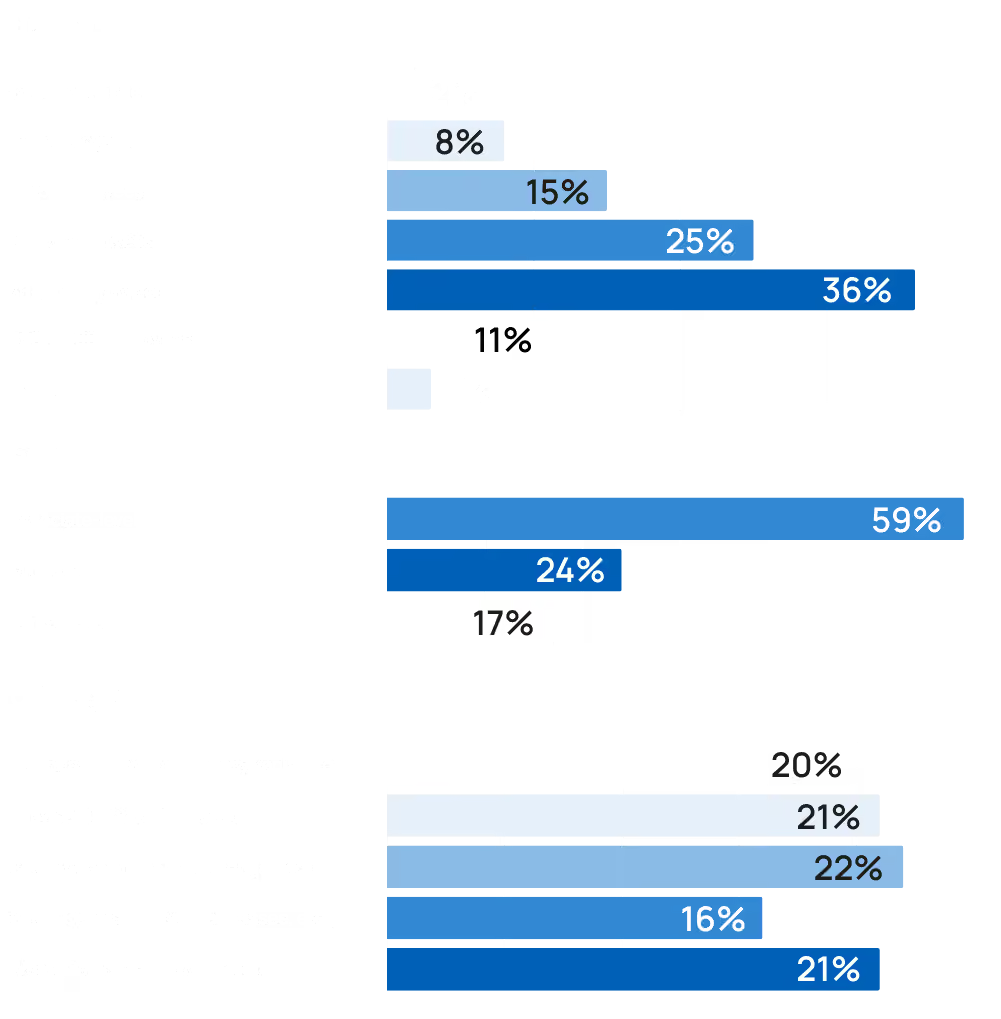
Survey Respondent Demographics
Additional Data
To complement the survey findings, this report also incorporates anonymized usage and customer data from Blue J’s own AI-powered tax research solution. These insights provide a view into how practitioners are applying AI in real-world workflows, offering additional context beyond the external survey data collected.
We would like to thank the tax and accounting professionals who participated in this survey, as well as Blue J’s customers, for sharing their time and insights.
About Blue J
Blue J is the leading AI-powered tax research solution, delivering defensible tax answers in seconds—all backed by a rigorously curated content library. Founded in 2015, Blue J is trusted by thousands of organizations, including Big Four firms and Fortune 100 companies. With over 9 million tax questions answered to date, Blue J empowers tax professionals to spend less time researching and more time applying their judgment where it matters most.
About CPA.com
CPA.com brings innovative solutions to the accounting profession, either in partnership with leading providers or directly through its own development. The company has established itself as a thought leader on emerging technologies and as the trusted business advisor to practitioners in the United States, with a growing global focus. The company’s core mission is to drive the transformation of practice areas, advance the technology ecosystem for the profession, and lead technology research and innovation efforts for practitioners. A subsidiary of the American Institute of CPAs, the company is also part of the Association of International Certified Professional Accountants, the world’s most influential organization representing the profession.