
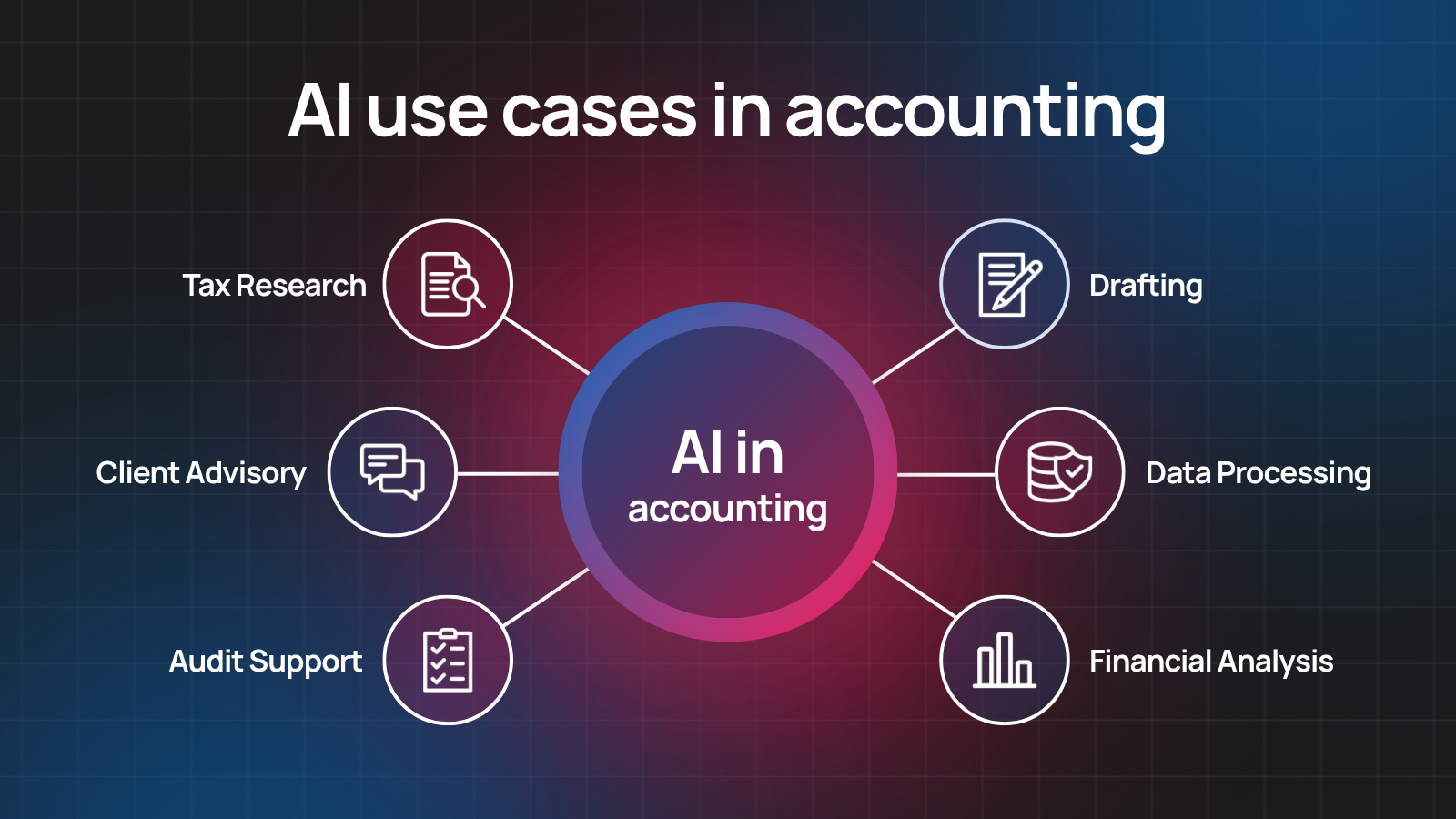
AI is already changing accountants' day-to-day work. You can now use AI to speed up tasks like data processing, document review, reconciliations, tax research, and drafting.
If you’re leading an accounting team, working as an accountant in a firm, or working as a sole practitioner, this raises the obvious question: will AI eventually replace accountants?
Not entirely. Routine and repeatable tasks are becoming easier to automate, while areas that rely on professional judgment, client context, and communication still need an accountant’s involvement.
In this article, we’ll look at where AI is already changing accounting, where it still struggles, the benefits and risks your firm should consider, and the skills accountants can build as AI becomes a bigger part of the job.
Benefits of using AI for accounting
AI can cut the time you spend on repetitive tasks, speed up research and analysis, and give your team more capacity for work that requires professional judgment.
Here are some of the major benefits of using AI for accounting:
Save time on repetitive work
One of the main advantages of using AI is that it helps you save time and focus on higher-level work. Accountants can focus more on reviewing complex issues, investigating exceptions, and making judgment calls.
According to the Bureau of Labor Statistics' Occupational Outlook Handbook, AI and robotic process automation can increase accountant productivity by automating routine tasks, freeing up time for analysis and higher-level responsibilities.
In practice, accountants can spend less time gathering and organizing information and more time reviewing the parts that require judgment. That could mean checking whether a tax position fits the client’s facts, investigating an unusual variance, weighing different interpretations of a rule, or deciding whether there is enough evidence to support a conclusion.
For example, you can use AI to conduct tax research and draft memos and emails to your clients about your findings. Instead of stringing together Boolean operators or keywords, you can use an AI tax research solution like Blue J to get from a tax question to a reviewable answer faster.
Blue J lets you ask your tax questions in plain language and review the sources supporting the answers. Once you’re done researching, you can also use Blue J to turn your findings into a first draft of a memo or an email.
Give your team more capacity
When AI reduces the time you spend on routine low-value tasks, your firm has more capacity for higher-value tasks. That capacity can go toward reviewing more complex work, taking on additional engagements, spending more time with existing clients, or expanding higher-value consulting services.
The Bureau of Labor Statistics concluded that automation is expected to make accountants' analytical and advisory duties more prominent as routine tasks become automated.
By using AI tools to automate routine tasks, accountants and firms have more flexibility in how they use their existing teams. That could mean having staff handle more engagements, improve turnaround times, or make more room for advisory work.
Get to financial insights faster
AI can help you reach the interpretation stage faster by reducing manual work. For example, instead of pulling numbers from several systems, lining them up in a spreadsheet, and comparing each line against the budget or prior period, you can use AI tools to organize the information and quickly flag changes.
McKinsey's 2025 survey of 102 CFOs also found growing use of GenAI across finance. In the finance teams McKinsey examined, AI helped with tasks such as preparing reports, building forecasts and scenarios, identifying what drove performance, and explaining why actual results differed from the budget.
McKinsey observed that CFOs and their teams are using AI to forecast more accurately, monitor working capital in real time, speed up reporting cycles, and surface new opportunities for cost savings.
Spend more time on review and professional judgment
AI can take on more of the routine preparation work, giving accountants more time to review complex issues, investigate exceptions, and make judgment calls.
According to Blue J’s 2026 AI Tax Research Solution Outlook Report, 77% of respondents who had adopted AI-powered tax research said it gave them more time for work that better uses their professional judgment.
In practice, accountants can spend less time gathering and organizing information and more time reviewing the parts that require judgment. That could mean checking whether a tax position fits the client’s facts, investigating an unusual variance, weighing different interpretations of a rule, or deciding whether there is enough evidence to support a conclusion.
Respond to clients faster
An AI-powered tax research solution can help you get from a client question to relevant authority and an initial analysis faster. You can then review the sources, apply the law to your client’s facts, and decide what belongs in the final response.
Blue J’s 2026 AI Tax Research Solution Outlook Report found that, among respondents who said AI saves time, 50% said they do or would use that time to improve client response and project-delivery timelines. Another 46% said they would use it to deliver higher-quality client advice.
What accounting tasks is AI already changing?
AI can now handle more of the work accountants once had to prepare manually. That gives you more time to review the results, work through the analysis, and focus on client needs.
Here are some of the main ways that shift is already showing up in everyday accounting work:
Tax research and drafting
Generative AI in tax can speed up several parts of the research process. Instead of building keyword or Boolean searches, you can ask a tax question in plain language and surface potentially relevant statutes, regulations, administrative guidance, cases, and other authorities.
AI can also help you pull those sources together, summarize the key findings, and prepare an initial analysis or draft. You still need to review the authority, check that it applies to the facts, and refine the final conclusion.
For example, Blue J can draw on primary tax authority as well as content from Tax Notes and IBFD. Tax Notes provides tax news, analysis, and commentary, while IBFD specializes in international and cross-border tax research. That wider source coverage can be useful when a question needs more than the underlying statute or regulation to understand how an issue has been interpreted or applied.
You can also see the sources supporting the answer and open them to check the authority for yourself. If the issue changes as you work through it, you can ask follow-up questions and keep building on the same research.
Blue J can also use the research to help prepare a first draft of a tax memo, client email, or response to the IRS or state tax authority. You can then review the draft, adjust the reasoning and wording, and finalize the response.
Document review and extraction
AI can reduce the time accountants spend manually reading and extracting information from contracts, invoices, statements, and other supporting documents.
Accounting firms can use optical character recognition to convert scanned documents into machine-readable text, while natural language processing can identify and extract relevant financial information from that text. Some tools can also compare information pulled from documents with spreadsheets or accounting systems and flag missing information or inconsistencies that need closer review.
Accountants can verify that the information was extracted correctly, determine which document terms matter for the accounting treatment, and investigate anything that appears incomplete or inconsistent.
Fraud detection and continuous monitoring
AI can scan transactions, journal entries, and account balances for unusual activity. It can flag duplicate payments, missing entries, unexpected balances, and unusual spending patterns that may be easy to miss during a manual review.
You still need to investigate each alert. That means checking the supporting records, understanding the context behind the transaction, and deciding whether it’s an error, a legitimate exception, or something that requires further investigation.
What accounting tasks does AI struggle with?
AI can handle plenty of accounting tasks, but there are still areas where human expertise matters:
- Understanding the full context: AI only knows what’s in the data. But it can’t factor in details that aren't on paper—like a client’s risk tolerance, unwritten business goals, or subtle background context. Without human judgment to bridge the gap between technical rules and off-the-record realities, automated recommendations can easily miss the mark.
- Handling unreliable or incomplete information: AI cannot fix bad source data simply by analyzing it faster. Missing transactions, incorrect records, inconsistent classifications, or unreliable documents can all lead to unreliable outputs.
- Knowing when an answer is wrong: generative AI can produce answers that sound convincing even when the underlying information is incorrect, outdated, or poorly supported. Accountants still need to check sources and challenge the output before relying on it.
- Making ethical decisions: AI software cannot take over an accountant's duties around integrity, objectivity, confidentiality, or professional care. Accountants still have to decide whether using AI is appropriate, protect sensitive client information, recognize potential bias, and challenge outputs that could lead to an unethical or misleading result.
The bottom line is that AI can help analyze the information, but you still need to decide whether the answer makes sense for the situation. AI may not have the full context behind a transaction, client decision, or accounting treatment, and it can still produce an answer that looks reasonable but is wrong.
For example, AI might flag a large expense as unusual because it falls outside the company’s normal spending pattern. You still need to check the supporting records and business context to determine whether it is an error, fraud, or a legitimate one-off purchase.
Considerations before using AI in accounting
Before using AI in accounting, you need to consider some of the major risks. In this section, we walk through some of the considerations to look out for.
AI hallucinations
AI can produce an answer that sounds convincing even when parts of it are wrong or completely fabricated. In accounting, that could mean an incorrect calculation, an unsupported assumption, or a nonexistent source.
A 2025 Frontiers in Artificial Intelligence study found overall hallucination rates ranging from 23.2% to 31.3% across five open-source models in its main evaluation. Vague prompts produced the highest average rate, at 38.3%. These figures show why you shouldn't treat a polished AI response as proof of accuracy.
For accountants, a hallucination can quickly become more than a bad answer. If incorrect information makes its way into tax research, an audit workpaper, a financial analysis, or client advice, your clients may make a decision based on information that was never reliable in the first place.
When using an AI tool, the safest approach is to treat AI output as a first pass, not a finished answer. Check the underlying facts, calculations, assumptions, and sources, especially when the result will support a tax position, audit conclusion, financial decision, or client advice.
Data security and privacy risks
Before your team uses an AI tool with client data, review the provider’s data policies. Some generative AI tools may retain prompts, use submitted information to improve their models, or give the provider broader rights over uploaded content.
This is important because once sensitive client information enters an unsecured or poorly governed AI tool, your firm may lose control over how that data is stored, accessed, or reused.
A data leak or unauthorized disclosure could expose confidential financial information, create privacy or compliance issues, damage client trust, and leave your firm responsible for explaining how the information was mishandled.
Accounting firms should also watch for shadow AI, where employees use personal or unapproved tools for work. This makes it harder to track where client data goes and how it is protected.
Shrinking of billable hours
For firms that still rely on hourly billing, there’s a major concern that AI may be shrinking billable hours by reducing the time it takes to deliver the same work.
When AI helps your team finish work faster, fewer billable hours can feel like a hit to revenue. But the value of the work hasn’t necessarily changed just because it took less time to complete. That’s why firms need to look beyond hourly billing and consider fixed-fee, subscription, hybrid, or value-based pricing instead. These models let you charge for the expertise and value you bring, not just the time spent on the work.
How can accountants safely embrace AI in their workflows?
With the right AI tools, accountants can focus on the skills that become more valuable as AI takes over more processing, research, and preparation.
Here are some of the ways accountants can safely embrace AI.
Get better at reviewing AI-generated work
As AI takes on more first-pass work, you need to get better at checking what it produces. Before you rely on an AI-generated answer:
- Check the facts and calculations: make sure the numbers, assumptions, and conclusions are accurate.
- Verify the sources: confirm that cited authorities exist and actually support the answer.
- Look for missing context: check whether the AI had enough information to reach a reliable conclusion.
When AI drafts a tax memo, summarizes research, or reviews financial documents, you still need to verify the result. You should also check for errors, confirm the reasoning and evidence, and decide whether the conclusion is reliable enough to share with a client.
Develop practical AI literacy
Accountants do not need deep technical expertise to use AI well. They do need to understand what the tools can do, where they can go wrong, and when human review is still required.
Practical AI literacy in this context includes asking clear questions, providing enough context, and checking AI-generated answers against reliable sources. It also means being able to spot hallucinations, question unsupported conclusions, and recognize when an answer needs more investigation.
Strengthen your judgment and critical-thinking skills
AI can produce an analysis or recommendation quickly, but accountants still need to decide whether it makes sense for the situation in front of them.
That means checking how the conclusion fits the client’s facts, questioning the assumptions behind it, considering other reasonable interpretations, and recognizing when important information is missing. It also means weighing risk and uncertainty rather than treating the first answer as final.
For accountants, strong judgment means knowing when an AI-generated answer is good enough to move forward, when it needs more research, and when the facts point to a different conclusion.
Develop stronger communication and client-facing skills
Many AI tools can now draft client-facing emails, memos, and reports, speeding up the writing process. You still need to review those drafts closely to make sure the technical analysis is accurate, the advice fits the client’s situation, and the wording is clear before anything goes out.
That review includes checking technical accuracy, ensuring the advice fits the client’s situation, and adjusting the tone and level of detail. Client communication still depends on the accountant. They need to ask the right questions, turn technical findings into clear advice, and explain the issue in a way the client can understand and use.
Move closer to advisory and decision support
AI can create more room for accountants to spend time on work that depends on judgment. This way, they can focus less on reporting what happened and more on advisory work.
That extra capacity can support work such as tax planning, scenario analysis, risk and exposure assessment, business planning, and identifying opportunities or problems in financial data.
Leverage AI in your tax research with Blue J
AI is unlikely to replace accountants, but it is already changing how tax work gets done. Practitioners can spend less time searching for information and preparing first drafts, and more time reviewing the research, applying professional judgment, and advising clients.
Blue J is built for that workflow. Its AI-powered tax research solution helps practitioners move from a complex tax question to a cited answer in less time. You can ask questions in plain language, review the supporting authority behind the analysis, and continue the research with follow-up questions when you need to dig deeper.
Blue J can also help carry the research into tax writing, so you can turn verified findings into a first draft of a client email, memo, or other deliverable without starting from a blank page.
With Blue J, you can:
- Ask complex tax questions in plain language instead of relying entirely on keyword or Boolean searches.
- Get citation-backed answers connected to the underlying tax authority.
- Open and review sources to confirm that they support the analysis.
- Continue researching with follow-up questions as new facts or issues come up.
- Draft client-ready tax writing from the research you have already completed.
Blue J helps reduce the time spent getting from question to answer, leaving more room for judgment, review, and client work.
Frequently asked questions on AI and accounting
How can accountants use AI for tax research?
Accountants can use generative AI to find relevant authority, synthesize findings, explore follow-up questions, and prepare a first draft of their analysis.
With Blue J, practitioners can ask complex tax questions in plain language, review the cited authority behind the answer, and continue the research with follow-up questions as new facts or issues come up. Blue J keeps the supporting sources close to the analysis, so practitioners can verify the authority and decide how it applies to the client’s facts.
Blue J also supports tax writing once the research is complete. Practitioners can turn reviewed research into a first draft of a client email, memo, or other tax document, then refine the explanation, recommendation, and final wording before it goes out.
How can accounting firms introduce AI without compromising research quality?
Start with tools and workflows that make verification easy. When firms evaluate AI tax research tools, they should look at the quality of the underlying sources, how citations are presented, whether practitioners can open the supporting authority, and how easily they can check an answer before relying on it.
Blue J supports this type of workflow by connecting AI-generated tax analysis with the sources practitioners need to review. Firms should also set clear expectations around human review, approved AI tools, and when an issue needs additional research or escalation.
Is it safe for accountants to put client information into AI tools?
It depends on the tool and how it handles your data. Before entering confidential client information, firms should know whether prompts and uploaded documents are stored, used for model training, shared with third parties, and protected by appropriate security controls.
How will AI affect billable hours and accounting firm pricing?
AI can reduce the time needed for research, drafting, data processing, and other accounting work. For firms that bill by the hour, faster work can put pressure on a model where revenue is closely tied to time spent. Some firms are considering alternative billing, like hybrid or value-based models.

Stay up to date