

A client emails at 4pm on a Friday with a stack of documents and asks one question: Do I have to pay this?
The file contains a tax notice, K-1, and a 1099 reporting income from work performed in a state where the client has never filed.
The issue, at a glance, looks simple.
But the roadmap to the right answer involves these steps, without compromising the quality of your analysis:
- Identifying the primary authorities that govern the client’s filing and tax obligations
- Understanding how those authorities have been interpreted and applied using relevant secondary sources
- Reaching a supportable conclusion quickly
When it comes to finding an answer, you generally have three options: external tax consulting, using a subscription platform, or prompting an AI-powered tax research tool.
Each has its benefits, depending on what you’re looking for.
This article discusses what tax research services—outsourced research, subscription platforms, and AI-native solutions—entail. For each type it will also compare turnaround time, cost, and the ability to verify the authorities supporting a conclusion.
What are tax research services?
Tax research services are the services and platforms tax professionals use to find, interpret, and cite authoritative answers to technical questions and tax issues.
The term covers three delivery models with different economics and turnaround time:
1. External tax consulting
Outsourcing tax research can reduce the workload of internal tax departments by enabling in-house teams to focus on higher-value priorities like tax planning, dispute resolution, and risk management.
External tax consulting typically takes three forms.
The first is internal escalation to a professional service firm, which may in turn use a service like the National Tax Office.
Deloitte and BDO, for example, maintain Washington National Tax teams to support their engagement teams on complex matters across a range of technical tax areas like corporate tax, international tax, partnership tax, and state and local tax.
These specialist teams provide deep technical expertise on complex issues, but that expertise typically comes with higher billing rates than routine tax compliance or general research work.
The external tax consulting groups provide deep technical expertise on complicated issues.
The second is a third-party commercial research service. In this model, an external tax researcher prepares a written memorandum supported by tax authorities and citations, usually billed hourly.
The National Society of Tax Professionals (NSTP), for example, provides written federal tax research reports with fees starting at a $150/hour minimum for members and $200/hour for non-members for the first hour, followed by additional hourly charges.
The third is referral to external individual specialists, like a tax attorney or consultant, when a practice requires expertise beyond its internal capacity.
Outsourcing provides access to specialized technical judgment and reduces research burden. Still, the practitioner gives up direct control over the research process and relies on external analysis curated by a tax specialist or a tax firm.
2. Subscription research libraries
A subscription library is an annual license to a searchable database of primary law plus editorial explanation.
Examples of subscription-based research libraries include Thomas Reuters Checkpoint, Westlaw, Bloomberg Law, Parker Pro Library, LexisNexis, and Tax Notes.
With a research library, you’d have to run the search, read the sources, and build the position.
Some of these research libraries now include an AI layer on top of the existing database, which improves your search, but may not assemble the final answer.
3. AI-native tax research platforms
With an AI-powered tax tool, like Blue J, you ask the question in plain language and receive a synthesized answer and clickable citations to the underlying primary sources.
AI-native tax solutions shift your work from assembling answers to verifying them. This gives you ample leverage to beat time pressure, match clients' demands, and manage staff constraints.
How long does tax research verification take under each service model?
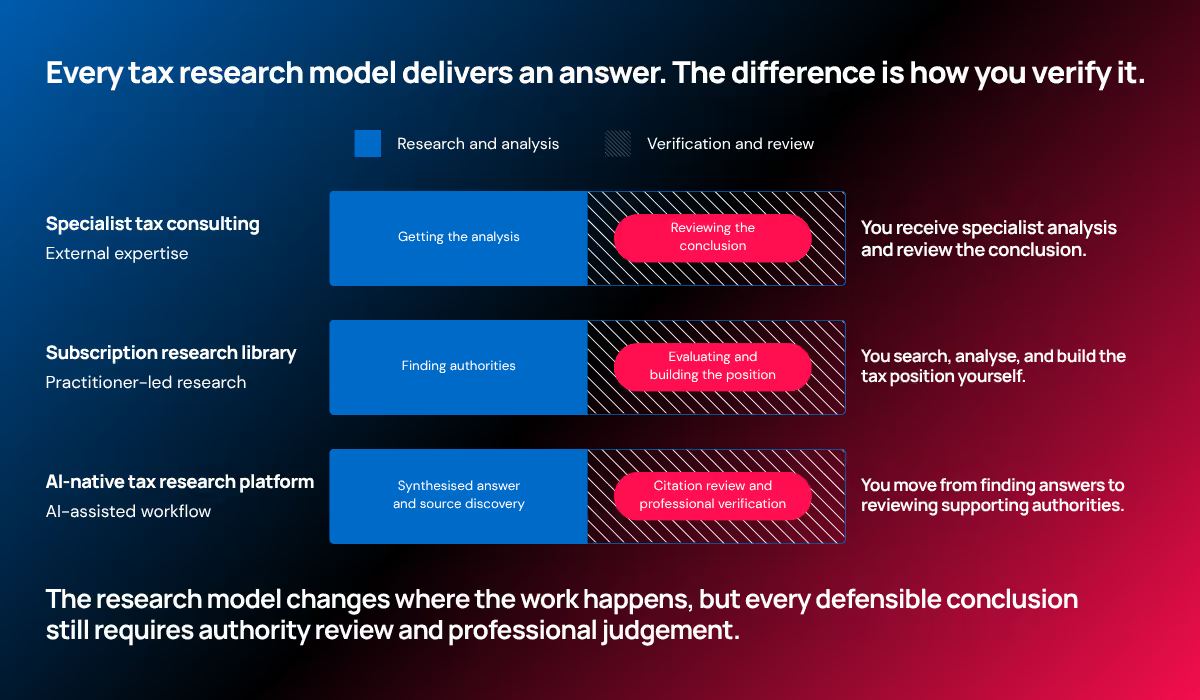
Here’s how long it takes, on average, to verify the three listed tax research models:
- Outsourced research may take days. Verification is bundled into the fee and the wait. The NSTP provides written federal tax research reports within 48 to 72 hours, on federal issues.
- Subscription research libraries may take hours. A practitioner conducts the search, reviews the relevant authorities, evaluates whether they support the conclusion, and prepares the final position. The time required depends on the issue's complexity and the practitioner’s expertise in the tax research process.
- AI-native tax research platforms can help reduce the time required to locate and organize relevant authorities. Depending on the platform, this may include synthesized answers, supporting citations, or tools that help practitioners review the underlying sources.
The main time savings come from reducing the time required to locate, review, and confirm the authorities supporting a tax research answer.
This distinction reflects our findings from more than 10,000,000 tax research questions submitted to Blue J, suggesting that practitioners require not only faster research but also conclusions supported by sources they can review.
These AI-native solutions and subscription research libraries can accelerate the research process. Their usefulness depends on whether practitioners can identify, evaluate, and confirm the authorities supporting the conclusions.
Here is a table that compares the three different research models at a glance:
What makes a tax research conclusion defensible and reliable?
A defensible tax research conclusion should allow a reviewer to trace the reasoning from the conclusion to the legal authority backing the findings (primary sources).
It rests on two foundations—the authority supporting the conclusion and the diligence applied in reaching it.
1. The conclusion must be supported by recognized tax authorities under Treas. Reg. §1.6662-4
When you’re evaluating a client’s tax position, Treas. Reg. §1.6662-4 explains which sources are considered when determining whether a taxpayer has substantial authority for a tax position under the accuracy-related penalty rules of Internal Revenue Code §6662.
A tax research conclusion is more defensible when the reasoning leads back to recognized authorities, such as the Internal Revenue Code, Treasury regulations, revenue rulings, revenue procedures, court decisions, tax treaties, congressional materials, and certain IRS guidance materials.
Secondary sources, such as opinions from tax professionals, tax periodicals, treatises, and professional commentary, can help explain an issue and guide further research. But they do not themselves constitute substantial authority; the weight of a position depends on the recognized authorities that support it.
A strong research conclusion therefore uses commentary as a guide while relying on the underlying legal authorities to support the final position.
2. The research process must show due diligence under Circular 230
Circular 230 §10.22 requires practitioners to exercise due diligence when preparing, approving, and filing returns, documents, affidavits, and other papers connected with IRS matters.
This requirement affects how a tax research conclusion is defended. Practitioners must also show that they reviewed the relevant authorities, considered the facts, and followed a reasonable process before reaching a conclusion.
So a tax research tool that displays its sources helps create that record during the research process. But a tool that provides an unsupported answer leaves the practitioner responsible for reconstructing the supporting analysis afterwards.
Using Blue J for defensible research when responding to an IRS notice
When responding to an IRS notice, you need to understand the issue, review the facts, identify the right tax authorities, and prepare a supported response.
This is where an AI-powered research workflow can help organize the process. Blue J's AI-native research workflow brings those steps into one flow, moving from question to analysis to verification and drafting.
Step one: type the question as you would ask a colleague, and attach any relevant documents.
For example: "If a taxpayer relied on an incorrect Form 1099 issued by a payer, does this reliance constitute reasonable cause to avoid accuracy penalties?"
Thanks to Blue J’s conversational capabilities, the analysis works from the specific facts in your question and addresses the actual issue rather than a generic tax scenario.
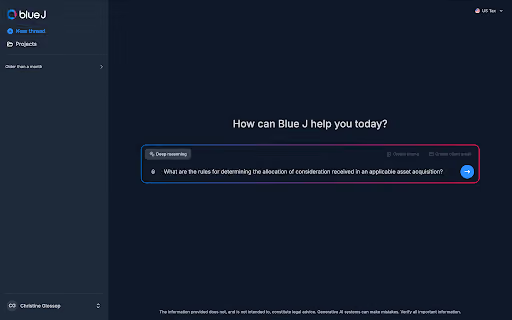
Once the initial analysis is available, the next step is to examine the reasoning behind it.
Step two: After generating an answer, Blue J presents the relevant authorities supporting the conclusion. You can review the cited sources, assess their relevance, and confirm how the authorities support the answer before relying on the analysis.
For example, when researching, “What are the rules for determining the allocation of consideration received in an applicable asset acquisition?” Blue J provides supporting citations alongside the answer, allowing the practitioner to move directly from the analysis to the underlying authorities.
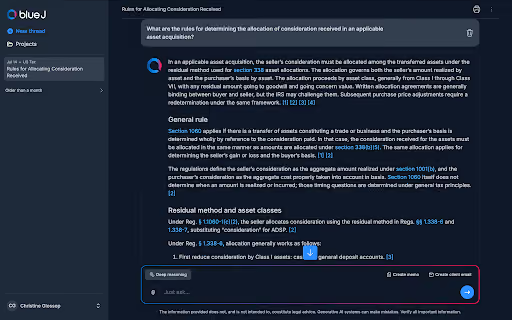
That leads directly to verification.
Step three: Check the cited authorities. After reviewing the answer, you can open the supporting citations and confirm that the underlying authorities support the conclusion.
For example, when researching the allocation of consideration in an applicable asset acquisition, Blue J links the analysis to relevant primary authorities, including Internal Revenue Code Section 1060 and related Treasury Regulations such as Sections 1.1060-1 and 1.338-6.
You can review the cited provisions directly, confirm how the rules apply, and determine whether the authorities support the proposed tax position before relying on the analysis.
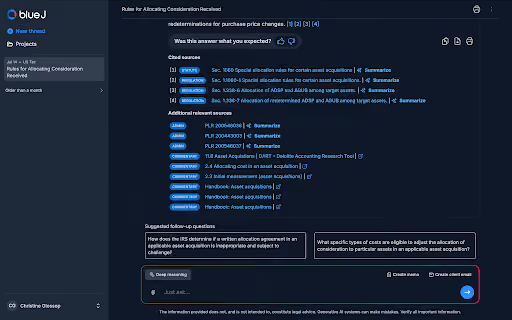
Once the position has been verified, the research can move into drafting.
Step four: Use the verified research to prepare the final response
After reviewing the answer and supporting authorities, the practitioner can use the verified research as the foundation for the final tax deliverable.
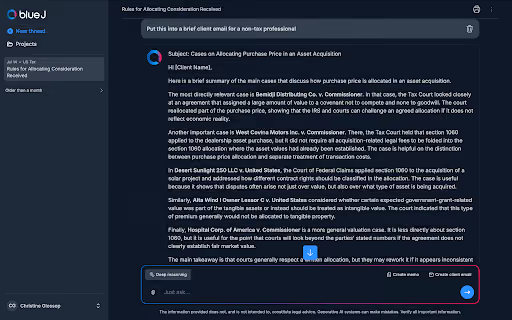
For example, the Blue J response on the allocation of consideration in an applicable asset acquisition provides the relevant conclusion, cited authorities, additional related sources, and follow-up questions that can help the practitioner refine the analysis.
The practitioner can then use the verified research to prepare the appropriate deliverable, such as a client explanation, tax memorandum, or response to a tax authority.
Another important feature of Blue J is its tax writing deliverable, whether you’re creating a tax memorandum or sending a response or conclusion to the IRS.
Blue J can draft a response that you can edit and finalize before sharing.
How to evaluate a tax research platform with your partners
Once you identify the benefits of an AI-powered tax research platform, the next step is helping partners assess its cost, value, and impact on the firm’s research process.
Your partners may evaluate the decision by looking at three areas:
- The cost of the platform
- The value it creates compared with current research methods
- How it helps the firm support its tax positions
Start with the cost model. Explain that traditional research methods often involve unpredictable expenses, including external research fees and significant staff time. A subscription-based platform provides a more predictable cost structure while reducing time spent on routine research tasks.
Next, demonstrate the platform’s value through faster workflows, easier access to authorities, and improved research efficiency. Highlight how the platform helps teams review supporting sources, validate conclusions, and maintain clear documentation of their research process.
Finally, evaluate the platform using real firm matters instead of prepared demonstrations. Where available, use a free trial to focus on current research needs, covering areas such as federal, state or local, and international tax issues where relevant.
Measure performance using criteria such as:
The purpose of this evaluation is to determine whether the platform helps the firm reach a supported conclusion faster and with a clearer verification trail.
Study our Blue J guide on evaluating AI tax research tools to learn how to test live matters across the areas the firm actually handles. Select three live questions: one federal issue, one state or local issue, and one international issue if the practice handles cross-border work.
Choosing the right tax research solution
The right tax research solution helps your team reach a supported conclusion quickly while giving you a clear path to verify the authorities behind it.
Whether you rely on outsourced expertise, subscription research libraries, or AI-native platforms, the goal remains to reduce research time without sacrificing confidence in the final position.
As tax research continues to evolve, the focus is shifting from simply finding answers to finding answers that can be reviewed, verified, and supported.
Explore how technology is shaping this next stage of tax research in our guide on the future of tax research.
Frequently asked questions about tax research services
1. Can I see exactly which sources an AI tax research platform used?
Yes, and you should insist on it. Blue J returns every answer with ranked, clickable citations, surfacing the exact passages so you can confirm they say what the answer claims. An answer you can trace takes seconds to check.
2. Does AI-powered tax research work for tax advisory as well as compliance?
It can support both. On compliance, that means landing on a defensible filing position, working through state tax nexus and apportionment, and sorting out depreciation and asset classification.
On tax advisory, it means entity structuring, cross-border and treaty analysis, estate and wealth transfer planning, and specialized credits such as R&D. Blue J and CPA.com's Transforming Tax Research covers how firms are applying it across both.
3. How much do tax research services cost?
Costs depend on the research model. Outsourced specialist research through accounting firms or tax advisers is typically the most expensive option because it involves expert analysis and review.
Commercial research services may charge hourly fees for written reports, and the National Society of Tax Professionals charges members $150 per hour and returns a written report in 48 to 72 hours. Subscription research libraries and AI-native platforms generally use annual or subscription-based pricing models.
The final cost depends on the complexity of the issue, the level of expertise required, and how much research support the firm needs.
4. Is an AI-generated tax answer defensible if the IRS challenges the position?
It depends. The authorities behind an AI-generated answer are what defend it under an IRS challenge. Treas. Reg. §1.6662-4 defines what counts as authority—the Internal Revenue Code, regulations, revenue rulings and procedures, and court cases. It expressly excludes conclusions drawn from treatises and periodicals.
So ask any platform whether its citation trail lands on that list. Circular 230 §10.22 then requires diligence, meaning reasonable care and a record of it. A tool that shows its sources builds that record as you work. Your review and your judgment stay exactly where they have always been.

Stay up to date